
Most businesses create content. Very few create content that consistently generates leads.
Here’s the honest breakdown of what separates the two — and where a content marketing agency fits into that gap.
If you’ve ever published a steady stream of blog posts, invested in social media marketing, and still found your leads stubbornly flat — you’re not imagining it. The content is there, but the pipeline isn’t moving. The frustrating truth is that content without a strategic foundation rarely converts. And that’s exactly the problem a good content marketing agency is built to solve.
This post breaks down why content-led lead generation works, what agencies actually do differently, and how to know if partnering with one makes sense for your business right now.
Why Content Marketing Works for Lead Generation
Before anything else, it’s worth grounding this in data. Content marketing isn’t a trend — it’s one of the most cost-efficient lead generation channels available in digital marketing today.
3×
More leads generated vs. traditional outbound, on average.
62%
Lower cost per lead compared to paid advertising alone.
47%
Of buyers consume 3–5 pieces of content before talking to sales.
What these numbers tell you is simple: your buyers are doing their research long before they fill out a contact form. If your content isn’t in front of them during that research phase — on Google, on LinkedIn, in their inbox — a competitor’s content is. That’s the opportunity cost of inconsistent content.
What "5× leads" actually means — and how it happens
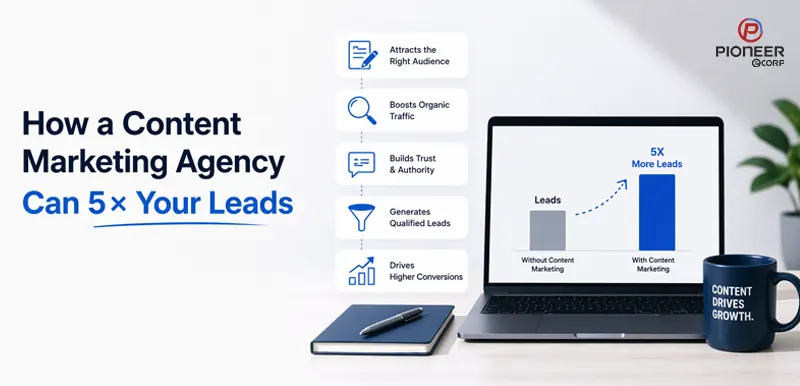
When people talk about a content marketing agency multiplying leads, the math isn’t magic. It’s the compound effect of doing several things right simultaneously — things that most in-house teams struggle to maintain alongside everything else on their plate.
Here’s what that looks like in practice:
1. SEO that targets buying intent, not just traffic
Most businesses that write blog content target broad informational keywords — “what is content marketing,” for example. Agencies that actually generate leads go deeper. They map content to the full search journey, from awareness-stage questions all the way to high-intent, decision-stage keywords that signal someone is ready to hire or buy. That kind of SEO strategy is what turns a blog into a lead channel rather than a traffic vanity exercise.
2. Social media marketing as a distribution engine, not just a presence
There’s a significant difference between posting on social media and using social media marketing strategically. A content marketing agency repurposes long-form content — articles, guides, research — into platform-specific formats that reach audiences who’ll never find you through search. LinkedIn posts that spark conversation. Short-form videos that explain a concept and drive click-throughs. Email newsletters that bring readers back to your site. Each channel feeds the others.
3. Content that matches where the reader is in their journey
Not every blog reader is ready to buy. A lead generation-focused agency builds content for all three stages — awareness, consideration, and decision — and connects them with clear calls to action, lead magnets, and internal linking structures that guide readers toward conversion. This is something most solo content efforts miss entirely: treating every article like a standalone piece rather than a node in a larger system.
The brands that win aren’t the ones producing the most content. They’re the ones with the most intentional content — built around what their audience is searching for and what moves them to act.
Common mistakes businesses make without agency support
Publishing without a keyword strategy
Content written from internal knowledge, without SEO research, rarely surfaces in search. You might be answering the wrong questions — or the right ones in the wrong format.
Treating every channel independently
SEO, social media marketing, email, and paid digital marketing work best as a connected system. Siloed efforts produce siloed results.
Measuring the wrong metrics
Page views and follower counts feel good but don’t tell you if content is generating pipeline. The right metrics are leads, qualified traffic, and content-attributed conversions.
Inconsistency killing compound growth
Content marketing compounds over time — but only when it’s consistent. A burst of activity followed by months of silence resets momentum every time.
What to look for before partnering with a content marketing agency
Not every agency will be the right fit. Here are the questions worth asking before you sign anything:
- Do they have case studies showing lead generation outcomes — not just traffic or engagement metrics?
- Is their SEO approach based on intent mapping, or just keyword volume?
- Do they integrate social media marketing with long-form content, or treat them as separate services?
- How do they measure ROI — and how often do they report on it?
- Do they take time to understand your sales cycle and buyer personas before creating anything?
How long before you see results?
This is the question every business asks — and deserves an honest answer. Organic content and SEO take time. Realistically, the first three months are about building the foundation: keyword strategy, content architecture, early publishing, and setting up distribution through email and social media marketing channels.
Months four through six are where traction begins. Content starts ranking, social posts start getting shared, and early lead data comes in. By month six to twelve, businesses with a consistent, well-executed content strategy typically see the kind of compounding returns — qualified inbound leads, lower cost per acquisition, growing domain authority — that justify the investment many times over.
The key word is consistent. This is why working with a dedicated team, rather than fitting content around everything else, tends to make the difference between results that plateau and results that grow.
Is a content marketing agency right for your business right now?
Content marketing agencies deliver the most value when a business has a clear target audience, a defined service or product, and the patience to invest in a channel that builds over time rather than delivering instant results like paid ads. If you’re looking for leads next week, paid digital marketing is probably the faster lever. If you’re building a long-term engine that keeps generating leads even when your ad budget dips — content is where the compounding happens.
The brands that grow consistently through content aren’t the ones who went viral once. They’re the ones who showed up with valuable, well-optimized content every single month — and built a digital marketing presence that their audience trusts.
Contact Best Content Marketing Agency
Let our experts build a data-driven social media strategy tailored to your goals.
Get Free Strategy