AI in Digital Marketing: Leads to Conversions
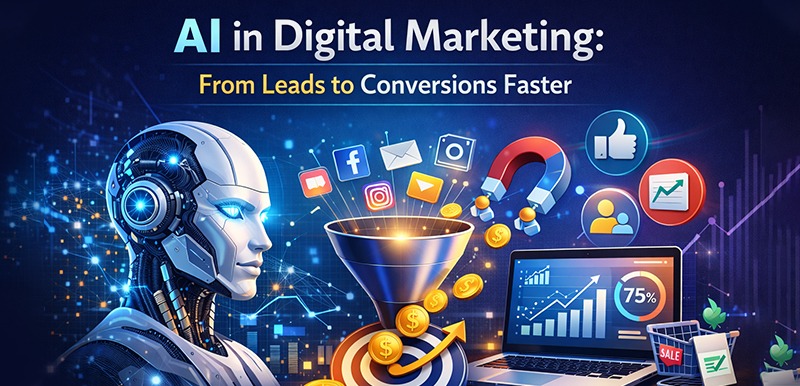
AI in digital marketing is transforming how businesses attract, nurture, and convert customers. Instead of relying on assumptions, brands now use machine learning, predictive analytics, and marketing automation to analyze behavior and optimize campaigns in real time.
The result is faster lead generation, smarter targeting, and measurable improvements in conversion rate optimization.
If campaigns are still managed manually without data-driven intelligence, efficiency is already being lost.
What Is AI in Digital Marketing?
Artificial Intelligence (AI) in digital marketing refers to the use of machine learning in marketing, automation systems, and predictive analytics to improve targeting, personalization, and campaign performance.
Unlike traditional marketing methods that rely on broad segmentation, AI marketing tools process large volumes of user data instantly and adjust strategies automatically.
Major platforms already integrate AI at their core:
- Google Ads uses Smart Bidding and automated campaign optimization
- Meta applies machine learning for ad delivery and audience expansion
- HubSpot and Salesforce use predictive lead scoring
- ChatGPT supports content automation and conversational marketing
AI studies customer behavior, engagement signals, click patterns, and purchase intent — then continuously improves performance based on that data.
Why AI Matters in Modern Digital Marketing
Digital competition is intense. Cost-per-click is rising. Organic visibility is harder to achieve. Manual decision-making slows growth.
AI-powered advertising provides three measurable advantages:
- Speed : Campaigns are optimized in real time rather than weekly.
- Accuracy : Predictive targeting identifies high-intent audiences instead of broad demographics
- Efficiency : Marketing automation reduces repetitive manual tasks and improves budget allocation
AI shifts marketing from reactive analysis to predictive execution.
AI in Lead Generation
Lead generation today is not about volume. It is about quality and intent.
Predictive Lead Scoring
AI analyzes:
- Website visits
- Page engagement time
- Download behavior
- Email interactions
- Conversion history
It then ranks leads based on probability to convert.
Sales teams no longer waste time on low-intent prospects. They focus on decision-ready buyers.
AI Chatbots and Conversational Marketing
AI-powered chat systems operate 24/7.
Example:
A visitor asks about pricing.
The chatbot collects budget range, service interest, and contact details.
The lead is automatically segmented and sent to CRM.
That is intelligent qualification without delay.
Smarter Ad Targeting
AI-driven personalization improves campaign precision by analyzing:
- Device usage
- Location signals
- Search intent
- Engagement behavior
Instead of targeting broad audiences, AI identifies users with higher conversion probability. This reduces cost per lead and improves return on ad spend.
AI in Social Media Marketing
Social media marketing is no longer driven by posting frequency alone. It is about predictive engagement.
AI tools evaluate:
- Likes
- Comments
- Shares
- Watch time
- Click-through rates
Machine learning models identify what content formats perform best and automatically adjust ad delivery.
This level of optimization would require constant manual monitoring without AI.
AI-powered advertising on social platforms increases relevance, engagement, and campaign efficiency.
AI for Conversion Rate Optimization (CRO)
Driving traffic is only half the strategy. Converting that traffic into customers is where AI makes a major impact.
Behavioral Personalization
AI dynamically adjusts website experiences based on:
- User location
- Returning visitor behavior
- Browsing history
- Device type
Returning visitors may see tailored offers, while new visitors receive educational content. This improves trust and accelerates decision-making.
Automated Email Marketing
Marketing automation systems trigger personalized emails based on:
- Form submissions
- Content downloads
- Abandoned inquiries
- Product page visits
Behavior-based automation improves engagement and strengthens long-term customer relationships.
Traditional Marketing vs AI-Driven Marketing
| Traditional Marketing | AI-Driven Marketing |
|---|---|
| Manual campaign adjustments | Real-time optimization |
| Broad audience targeting | Predictive targeting |
| Generic email blasts | Behavioral personalization |
| Fixed ad bidding | Smart bidding algorithms |
| Periodic performance review | Continuous performance modeling |
The difference is measurable in efficiency and ROI.
How AI Reduces Marketing Costs
Many businesses assume AI increases expenses. In practice, it often reduces inefficiencies.
AI reduces costs by:
- Eliminating low-performing ad spend
- Allocating budget toward high-converting audiences
- Automating repetitive optimization tasks
- Improving targeting precision
Over time, predictive analytics and AI marketing tools lower acquisition cost while increasing profitability.
Real-World Application Example
Consider a business promoting digital marketing services.
Without AI:
- Broad targeting
- Generic landing pages
- Manual bid adjustments
- Slower optimization
With AI integration:
- Intent-based audience segmentation
- Dynamic landing page personalization
- Automated bidding strategies
- Predictive remarketing
The difference is not theoretical. It directly impacts lead quality and revenue velocity.
The Future of AI in Digital Marketing
AI adoption will continue accelerating through:
- Generative AI for ad creatives
- Predictive customer journey mapping
- AI-based voice search optimization
- AI-powered dynamic landing pages
- Autonomous campaign management
As machine learning models evolve, marketing decisions will become increasingly data-driven and automated.
Businesses that integrate AI early build stronger competitive positioning. Those who delay adoption face rising acquisition costs and slower growth.
Frequently Asked Questions
How does AI improve lead generation?
AI analyzes behavioral signals and engagement data to identify high-intent prospects. Predictive lead scoring improves conversion probability and sales efficiency.
What are examples of AI marketing tools?
Platforms like Google Ads, Meta Ads Manager, HubSpot, Salesforce, and ChatGPT integrate AI for targeting, automation, personalization, and campaign optimization.
Is AI suitable for small businesses?
Yes. Many AI marketing tools are scalable and affordable. Even basic automation improves efficiency and performance.
Is AI better than traditional digital marketing?
AI enhances traditional digital marketing by adding predictive analytics, automation, and real-time optimization. It improves accuracy and reduces wasted spend.
Conclusion
AI in digital marketing transforms raw data into actionable intelligence. It improves targeting precision, automates campaign optimization, and accelerates conversions.
The shift from manual execution to AI-driven strategy is not optional for growth-focused businesses.
Adopting AI is not about following a trend. It is about staying competitive in an increasingly data-driven marketing environment.