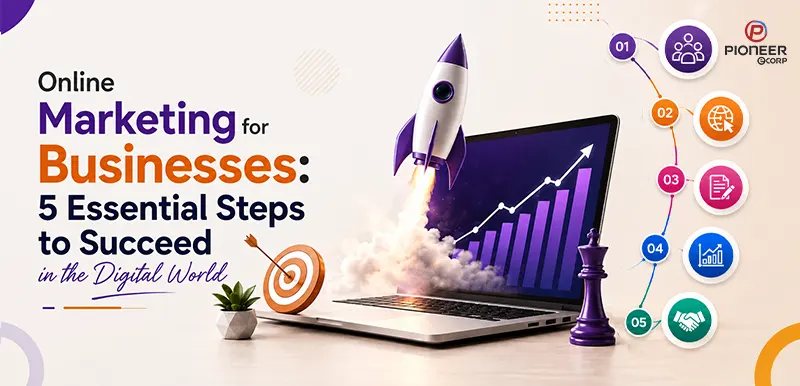
Online Marketing for Businesses has become a key part of reaching customers, building brand visibility, and generating consistent business opportunities. As more people search, compare, and purchase online, businesses need a clear strategy to stay visible where their customers are looking.
A successful online presence is not built through one channel alone. It requires a combination of the right platforms, useful content, customer-focused messaging, and continuous performance analysis.
Table of Contents
- Build a Professional Online Presence
- Understand Your Target Audience
- Strengthen Your Search Visibility
- Connect With Customers Through Social Media
- Turn Online Visitors Into Qualified Leads
- Frequently Asked Questions
- Conclusion
1. Build a Professional Online Presence
The first step in online marketing for businesses is creating a strong digital foundation. Your website is often the first interaction a potential customer has with your brand, so it needs to create a positive impression quickly.
A professional website should clearly explain what your business offers and why customers should choose you. Important information should be easy to find, including your services, products, contact details, location, and enquiry options.
Your website should also be:
- Mobile-friendly
- Fast and easy to navigate
- Secure and reliable
- Simple to understand
- Designed with clear calls to action
For example, a company offering industrial equipment should create dedicated service or product pages rather than placing all information on one general page. This makes it easier for visitors to find exactly what they need.
A strong digital presence also extends beyond your website. Business directories, local listings, review platforms, and other relevant online profiles can help customers discover and evaluate your company.
Ready to Grow Your Business Online?
Build a stronger digital presence with a strategy designed around your business goals.
2. Understand Your Target Audience
No marketing strategy can work effectively without knowing who you are trying to reach. Businesses should understand their customers before deciding what content to create or where to promote it.
Start by identifying your ideal customers and their requirements. Consider their location, industry, interests, challenges, purchasing behaviour, and common questions.
Keyword research is particularly useful because it shows what people are actively searching for. A customer looking for an immediate service has different intent from someone researching a topic for the first time.
For example, a person searching for “commercial generator rental” may already be looking for a provider, while someone searching for “how does a diesel generator work” may only be gathering information.
Understanding these differences helps businesses create content that matches different stages of the customer journey.
A useful audience research process includes:
- Identifying your ideal customer
- Studying customer problems and needs
- Researching relevant search terms
- Analysing competitor positioning
- Understanding purchasing decisions
- Creating content around customer questions
The more accurately you understand your audience, the easier it becomes to create marketing messages that attract the right people.
3. Strengthen Your Search Visibility
Search engines play an important role in how customers discover businesses. When people need a product, service, or solution, they often begin with a search.
This is where a professional SEO service can help businesses improve their organic visibility and attract relevant visitors.
SEO involves much more than inserting keywords into website content. A well-planned strategy can include technical improvements, content optimization, internal linking, local SEO, website structure, and user experience.
Businesses should focus on creating pages that genuinely answer what users are looking for.
For example, a company selling medical furniture could create separate pages for hospital beds, patient waiting chairs, examination tables, and other products. Each page can target a specific search intent and provide detailed information for potential buyers.
Content should also be updated when information becomes outdated. Search trends, customer expectations, and competitors can change over time, so maintaining existing pages is just as important as creating new ones.
A consistent SEO strategy can help businesses:
- Improve organic visibility
- Attract relevant search traffic
- Build authority within their industry
- Reach customers with specific needs
- Generate long-term website opportunities
SEO is not an overnight solution. Results depend on competition, website quality, content, authority, and the consistency of optimization efforts.
4. Connect With Customers Through Social Media
Social platforms give businesses an opportunity to communicate directly with their audience and build familiarity around their brand.
Social media marketing can be particularly useful for businesses that want to showcase products, share expertise, educate customers, and encourage conversations.
However, businesses do not need to be active on every platform. The better approach is to identify where their target audience spends time and build content specifically for those channels.
Different types of content can serve different purposes:
- Educational posts can demonstrate expertise.
- Product videos can explain features and benefits.
- Customer stories can build trust.
- Short-form videos can increase reach.
- Industry updates can keep followers informed.
- Behind-the-scenes content can make a brand more relatable.
For example, a B2B company may use LinkedIn to share industry insights, case studies, and professional content. A consumer brand may find visual platforms more effective for product demonstrations and promotional content.
The objective should not simply be gaining followers. Businesses should focus on meaningful engagement, website visits, enquiries, brand awareness, and customer relationships.
5. Turn Online Visitors Into Qualified Leads
Attracting visitors is only one part of digital growth. Businesses also need to give those visitors a clear reason and opportunity to take the next step.
This is where lead generation becomes important.
A visitor who finds your website should be able to understand your offering and contact your business without unnecessary effort. Clear calls to action can encourage visitors to request information, schedule a consultation, call the business, or submit an enquiry.
Common lead-generation methods include:
- Contact forms
- WhatsApp enquiry buttons
- Phone call options
- Service-specific landing pages
- Consultation forms
- Email campaigns
- Downloadable resources
- Online advertising
The quality of the landing page matters. If an advertisement promises information about a particular service but sends users to a generic homepage, the visitor may leave without taking action.
Businesses should also measure what happens after visitors arrive.
Important performance indicators include:
- Website conversions
- Enquiry volume
- Conversion rate
- Cost per lead
- Qualified leads
- Customer acquisition cost
- Revenue generated from campaigns
For example, if a website receives thousands of visitors but very few enquiries, simply increasing traffic may not solve the problem. The business may need to improve its content, offer, page design, trust signals, or calls to action.
Creating a Sustainable Digital Strategy
The five steps above should not operate independently. They work best as parts of one connected strategy.
Start with a strong website and understand the audience you want to reach. Build search visibility by creating useful, optimized content. Use social platforms to communicate with your audience and strengthen brand awareness. Finally, create clear conversion paths that turn interested visitors into enquiries and customers.
Digital marketing should also be treated as an ongoing process rather than a one-time campaign. Businesses should regularly review performance and identify what is working and what needs improvement.
A monthly review can examine:
- Website traffic
- Search performance
- Content engagement
- Social media results
- Enquiry trends
- Conversion rates
- Marketing costs
This data helps businesses make decisions based on actual performance rather than assumptions.
Frequently Asked Questions
What is online marketing for businesses?
Online marketing for businesses involves promoting products, services, or brands through digital channels such as websites, search engines, social platforms, email, and online advertising. The goal is to reach potential customers and support business growth.
Why is an online presence important for a business?
Customers increasingly research businesses online before making purchasing decisions. A professional online presence helps a company establish credibility, provide useful information, and make it easier for potential customers to contact the business.
How can SEO help a small business?
SEO can help small businesses improve their visibility when potential customers search for relevant products or services. A focused strategy can help them compete for specific, valuable search terms without relying entirely on paid advertising.
Which social media platform is best for businesses?
There is no single best platform for every business. The right choice depends on the target audience, industry, content type, and business goals. Companies should prioritize platforms where their potential customers are most active.
How can a business generate more online enquiries?
Businesses can improve enquiries by targeting relevant audiences, creating useful landing pages, adding clear calls to action, improving website usability, and testing different marketing channels. Tracking conversions can help identify which strategies generate the most valuable leads.
Conclusion
Online Marketing for Businesses is most effective when it focuses on the complete customer journey rather than individual marketing activities.
A professional online presence creates the foundation. Audience research helps businesses understand what customers need. Search optimization improves visibility, social platforms build engagement, and effective conversion strategies turn online interest into business opportunities.
The key is consistency. Businesses that continuously improve their website, content, search visibility, customer communication, and conversion process are better positioned to build a stronger digital presence and achieve sustainable growth.
Ready to Take Your Online Marketing to the Next Level?
Connect with our team and create a digital marketing strategy that supports your business growth.