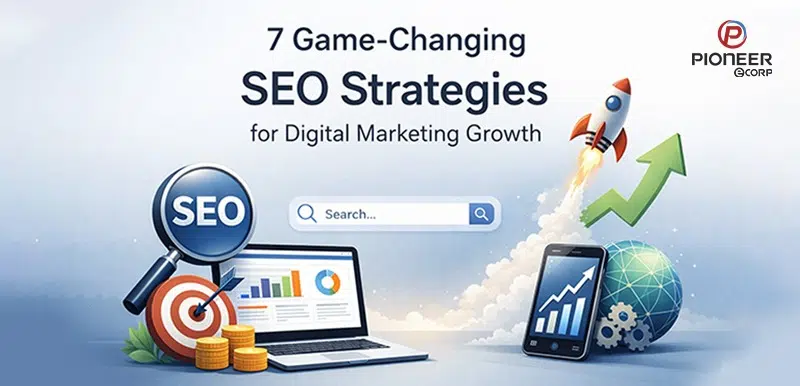
7 Game-Changing SEO Strategies
Every business today competes in a crowded online marketplace where visibility determines success. Implementing the right SEO strategies for digital marketing is essential to improve search rankings, attract qualified traffic, and grow your brand online. Partnering with an experienced digital marketing agency in Chennai can help businesses build a sustainable online presence and outperform competitors.
At Ecorp, we use a proven system of SEO strategies for digital marketing that work together to accelerate online growth. These strategies focus on improving search visibility, enhancing website performance, and creating valuable content that attracts the right audience.
In this guide, we explore 7 powerful SEO strategies for digital marketing that help businesses rank higher on search engines, increase organic traffic, and generate consistent leads. When implemented correctly, these strategies create a strong foundation for long-term digital marketing success.
Table of Contents
- Deep Audience Understanding Before You Do Anything Else
- Crafting Content That Ranks AND Converts
- Website Architecture That Search Engines Love
- Earning Credibility Through Strategic Partnerships
- Turning Social Platforms Into Traffic Funnels
- Capturing Your Geographic Market Share
- Converting Visitors Into Revenue-Generating Customers
- Selecting Your Digital Marketing Partner in Chennai
- Quick Answers to Strategic Questions
- Your Next Steps to Market Dominance
Strategy 1: Deep Audience Understanding Before You Do Anything Else
Most businesses jump straight into keyword lists without truly understanding their buyers. This backward approach wastes months and budgets on rankings for terms nobody actually needs.
Real SEO starts with detective work. You need to map out your buyer’s entire thought process: What problems wake them up at 3 AM? When did they first realize this problem existed? Who else did they ask before searching online? Which specific phrases do decision-makers use versus researchers?
Implementing this approach:
- Interview 10-15 current customers about their buying journey—record the exact words they use
- Analyze your sales team's conversations—they know which objections come up most often
- Track competitor reviews to understand pain points people publicly complain about
- Separate your audience into buying stages: awareness, consideration, decision-making
- Build keyword clusters around these stages, not just volume numbers
When you understand intent at this depth, your SEO strategy naturally aligns with customer psychology. You stop competing on vanity metrics and start winning on metrics that actually matter—qualified visitors who become customers.
Strategy 2: Crafting Content That Ranks AND Converts
The biggest content mistake happens when you optimize for search engines instead of people. You end up with blog posts stuffed with keywords but empty of actual value. Google now actively penalizes this approach.
High-performing content answers the exact question someone typed into Google while proving you’re uniquely qualified to answer it. It shows experience, not just theory. It acknowledges complexity instead of oversimplifying.
Content types that dominate rankings:
- Implementation guides—show the actual process someone needs to follow with real screenshots
- Original research or case studies revealing surprising data from your market
- Transparent comparisons between solutions (including ones you don't sell)
- Mistakes you've observed and how to avoid them—vulnerability builds trust
- Updated content that reflects current market conditions, not last year's information
This content style naturally attracts backlinks because other professionals want to cite it. It keeps readers on your page longer because they’re actually learning something. And it converts better because people trust the source before they ever think about buying.
Strategy 3: Website Architecture That Search Engines Love
Think of your website’s technical foundation as real estate location. No matter how beautiful your house is, if it’s in an inaccessible location, few people visit. Similarly, a slow website with broken links and poor mobile experience loses customers to competitors before they even read your content.
Google measures user experience signals: page speed, mobile optimization, how quickly people find what they need. These factors influence rankings as much as content quality does.
Critical technical elements:
- Page loading speed under 3.0 seconds
- Flawless mobile experience—50%+ of search traffic comes from phones
- Internal linking structure that distributes authority and helps users navigate logically
- Clean URL structure that tells visitors and search engines what each page covers
- Proper redirects when moving or reorganizing pages so you don't lose ranking value
An SEO agency’s technical audit usually reveals 50+ fixable issues that are currently costing you rankings. Addressing these creates quick wins that compound as your content strategy takes hold.
Strategy 4: Earning Credibility Through Strategic Partnerships
Backlinks remain Google’s primary trust signal, but the game has changed completely. You can’t buy your way to authority anymore. Instead, you earn it by creating things worth linking to and building genuine relationships with people who have influence in your space.
Your competitors have backlinks. What they often lack is strategic relationships with journalists, industry leaders, and complementary businesses who could amplify your message.
Building real authority:
- Create something your industry doesn't have yet—original research, proprietary data, unique tools
- Pitch relevant journalists with stories about your market, not about your product
- Pitch relevant journalists with stories about your market, not about your product
- Build a community around your content where others want to participate and share
Real authority takes longer to build than buying links, but it’s unassailable. When your competitors try to copy your tactics, they can’t replicate the relationships you’ve developed.
Strategy 5: Turning Social Platforms Into Traffic Funnels
Most businesses treat social media as a broadcast network: post content, hope people notice, repeat. This approach generates vanity metrics while barely moving business results. Real social media marketing works differently.
Social platforms are where your audience already hangs out. Instead of interrupting them with sales messages, you build genuine connections by participating in their conversations and solving their stated problems.
Strategies that convert followers to customers:
- Answer every comment and message within 24 hours—consistency builds your reputation as responsive
- Create content series that make people come back to your profile regularly for value
- Use polls and questions to start conversations where you actually learn about audience needs
- Share customer success stories rather than talking about yourself
- Direct engaged followers to your deep-dive content with specific links, not vague CTAs
Social media marketing amplifies your SEO efforts by sending referral traffic to ranking content and expanding your reach through organic shares. Done right, it’s like having a permanent amplifier for your message.
Strategy 6: Capturing Your Geographic Market Share
If you serve customers in a specific city or region, you have an enormous advantage that most local businesses completely waste. While your competitors spread their efforts nationally, you can dominate your immediate market with focused effort.
Being a digital marketing agency in Chennai means you understand local business dynamics, community networks, and regional preferences. You’re not just a vendor—you’re part of the local ecosystem. Leverage this advantage.
Dominating your local market:
- Optimize your Google Business profile like it's your most important marketing asset—weekly updates matter
- Create location-specific content about doing business in your city, local events, area growth
- Build citations on local directories and ensure name/address consistency everywhere
- Partner with other local service providers for cross-promotion and referrals
Local search is fundamentally less competitive than national markets. You can achieve first-page rankings with a fraction of the effort required nationally, and local customers often trust you more.
Strategy 7: Converting Visitors Into Revenue-Generating Customers
Ranking in Google means nothing if visitors bounce immediately. Lead generation isn’t about collecting email addresses—it’s about identifying genuinely interested prospects and nurturing them through a relationship.
Every visitor carries potential value. The businesses winning big convert a small percentage of visitors into conversations, and then convert a percentage of those conversations into customers. Small percentages, applied consistently, generate massive revenue.
Building a conversion machine:
- Only ask for contact information when someone has proven genuine interest through engagement
- Offer something genuinely valuable in exchange for contact info, not just 'subscribe to updates'
- Follow up with new leads within 4 hours with something helpful, not a sales pitch
- Track which pages and offers generate the highest-quality leads, then optimize those
Lead generation is about conversion efficiency. A smaller number of highly qualified leads beats a massive list of uninterested contacts. Focus on quality consistently, and your revenue will follow.
Selecting Your Digital Marketing Partner in Chennai
You could theoretically implement these strategies yourself. You have the internet. You have time. But there’s a reason successful businesses hire experienced professionals: we’ve made the mistakes already so you don’t have to.
What a legitimate SEO agency brings:
- Tested systems across dozens of businesses and industries—patterns emerge that you can't see from one company
- Deep knowledge of your regional market, local competition, and regional customer preferences
- Investment in tools and technology that would be prohibitively expensive individually
- Investment in tools and technology that would be prohibitively expensive individually
- Accountability through reporting and transparent metrics on what's working
A good digital marketing agency in Chennai doesn’t impose templates. Instead, they diagnose YOUR specific situation and build a strategy around that diagnosis.
Quick Answers to Strategic Questions
Q: What's the typical timeline to see meaningful SEO improvements?
A: Quick wins (technical fixes, speed improvements) show immediately. Ranking improvements typically appear within 2-3 months. Significant, sustainable growth usually requires 6+ months of consistent effort. This timeframe reflects the reality that you’re building authority, not gaming algorithms.
Q: Should we invest in paid advertising while doing SEO?
A: These work best together, not separately. Paid ads generate immediate traffic while your organic rankings develop. As organic rankings improve, shift budget from paid to organic. Most smart businesses run both for 6-12 months during the SEO ramp-up phase.
Q: How do we know if an agency is actually delivering results?
A: Ask for regular reporting on: organic traffic growth, rankings for specific keywords, conversion rates from organic traffic, and cost per acquisition through organic channels. Vanity metrics like total website visitors or social followers don’t matter—only metrics connected to business revenue matter.
Q: Is it possible to rank in competitive industries?
A: Yes, but strategy matters more. Instead of competing nationally on obvious keywords, start with regional or long-tail keywords where you can achieve quick wins. Build authority, then gradually target harder terms. Many businesses fail by trying to win the hardest battles first.
Q: What makes a strong SEO foundation that compounds over time?
A: Strong fundamentals: great technical setup, genuinely helpful content, authority built through real relationships, and consistent optimization based on performance data. This foundation means future content ranks faster because your domain authority works in your favor.
Your Next Steps to Market Dominance
Digital marketing complexity comes from information overload, not actual complexity. The fundamental approach is straightforward:
- 1. Understand exactly who your customer is and how they think
- 2. Create content that genuinely solves their problems better than anything else available
- 3. Ensure your website works perfectly on all devices and loads instantly
- 4. Build real relationships that lead to earned credibility and backlinks
- 5. Use social platforms to amplify your message and nurture connections
- 6. Optimize for your specific geographic market relentlessly
- 7. Convert interested visitors into ongoing customer relationships
That’s genuinely everything. No black hat tactics, no algorithm gaming, no complex frameworks. Just execution of fundamentals.
The businesses that dominate their markets are the ones who started this journey sooner than their competitors. They didn’t need to be faster or smarter—they just needed to start while others were still planning.
Your choice is simple: continue with the status quo and watch your competitors gain market share, or implement this system and watch your business grow. The framework is proven. The only remaining variable is execution.