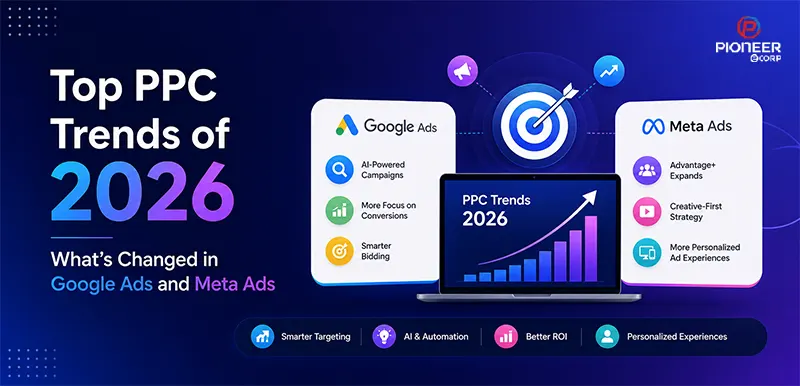
Top PPC Trends of 2026: What's Changed in Google Ads and Meta Ads
The Top PPC Trends of 2026 are reshaping how businesses approach paid advertising across Google Ads and Meta Ads. From AI-driven campaign automation to privacy-focused targeting, the PPC landscape is no longer about simply running ads — it’s about smarter optimization, predictive audience behavior, and platform adaptability.
Brands investing in digital marketing and social media marketing must understand these changes now, or risk wasting budget on outdated strategies that no longer perform.
Table of Contents
- Introduction
- AI-Powered Campaigns Are Dominating PPC
- Search Intent Matters More Than Keywords
- Performance Max Campaigns Have Evolved
- Meta Ads Focus More on Creative Automation
- First-Party Data Is Becoming Essential
- Video Ads Are Outperforming Static Creatives
- Voice and Visual Search Ads Are Growing
- Smart Bidding Has Become More Aggressive
- User-Generated Content (UGC) Ads Are Winning
- PPC and SEO Are Becoming More Connected
- Conclusion
- FAQs
Introduction
PPC advertising in 2026 looks very different compared to just a few years ago. Platforms like Google and Meta are aggressively pushing automation, AI optimization, and machine learning-driven targeting. Businesses that still rely on manual keyword stuffing, broad targeting, or generic creatives are seeing declining ROI.
The biggest shift? Platforms now reward advertisers who provide better audience signals, stronger creatives, and conversion-focused landing pages rather than just increasing ad spend.
If your strategy hasn’t evolved, your competitors are already ahead.
AI-Powered Campaigns Are Dominating PPC
Artificial intelligence is now the backbone of both Google Ads and Meta Ads. In 2026, AI handles:
- Audience targeting
- Budget allocation
- Ad placement optimization
- Creative recommendations
- Bid adjustments
- Conversion prediction
Google’s AI can now predict user behavior with significantly better accuracy using historical intent signals and browsing patterns.
Meta’s Advantage+ campaigns have also become far more automated. Advertisers who fight automation instead of learning how to guide it are struggling to scale campaigns profitably.
What This Means for Advertisers
You no longer control every tiny setting manually. Your job is now to:
- Feed platforms high-quality data
- Create better ad creatives
- Improve landing page conversion rates
- Define strong audience signals
The platforms handle optimization faster than humans can.
Search Intent Matters More Than Keywords
One major change in the Top PPC Trends of 2026 is that exact-match keyword obsession is dying.
Google now heavily prioritizes:
- User intent
- Contextual understanding
- Behavioral signals
- Predictive search behavior
A campaign targeting “best generator rental company” may also trigger for related commercial intent searches without needing exact-match targeting.
The Problem Most Businesses Still Have
Many advertisers still:
- Overuse broad keywords
- Ignore search intent
- Send traffic to weak landing pages
- Focus on clicks instead of conversions
That approach burns budget fast.
Winning campaigns now align ad copy directly with user intent and solve a clear problem immediately.
Performance Max Campaigns Have Evolved
Performance Max campaigns were controversial when first introduced. In 2026, they’ve become far more effective because Google improved reporting transparency and audience segmentation.
Performance Max now integrates deeply across:
- YouTube
- Gmail
- Search
- Discover
- Maps
- Shopping
Businesses using strong creative assets and accurate conversion tracking are seeing excellent results.
However, There’s a Catch
Performance Max is not magic.
If your:
- Website is slow
- Conversion tracking is broken
- Creatives are weak
- Offer is poor
AI will optimize bad data faster.
That means automation amplifies both strengths and weaknesses.
Meta Ads Focus More on Creative Automation
Meta Ads in 2026 rely heavily on automated creative testing.
Facebook and Instagram now dynamically test:
- Headlines
- Hooks
- CTAs
- Video formats
- Captions
- Thumbnails
Instead of building one perfect ad, brands now create multiple creative variations and allow Meta’s AI to identify winners.
Why Most Meta Campaigns Fail
Most businesses still create boring ad creatives that:
- Look overly corporate
- Feel fake
- Lack emotional triggers
- Ignore mobile-first behavior
Users scroll aggressively. Weak creatives die instantly.
Winning ads now look:
- Native
- Authentic
- Fast-paced
- Short-form
- User-generated
First-Party Data Is Becoming Essential
Privacy regulations and cookie restrictions have changed PPC advertising permanently.
Third-party tracking is becoming weaker every year. Businesses that depend entirely on platform data are losing targeting accuracy.
That’s why first-party data is becoming critical.
Examples of First-Party Data
- Email lists
- Website visitor data
- CRM information
- Purchase history
- Lead forms
- Customer behavior tracking
Businesses collecting and organizing their own audience data are outperforming competitors significantly.
This is no longer optional in digital marketing.
Video Ads Are Outperforming Static Creatives
Short-form video is dominating both Google and Meta ecosystems.
Platforms prioritize:
- Reels
- Shorts
- Vertical videos
- Fast-moving visual content
Static image ads still work in some industries, but video ads consistently produce:
- Better engagement
- Lower CPC
- Higher CTR
- Stronger conversions
What Actually Works in 2026
High-performing PPC videos usually:
- Grab attention in first 3 seconds
- Show the product immediately
- Use subtitles
- Focus on customer pain points
- End with a strong CTA
Long introductions kill retention.
Voice and Visual Search Ads Are Growing
Voice search usage has increased massively through:
- Smart devices
- AI assistants
- Mobile search
At the same time, visual search is growing through Google Lens and image-based discovery.
This changes keyword behavior completely.
Users now search conversationally:
- “Which generator rental company is open near me?”
- “Best digital marketing agency for startups”
Advertisers must optimize campaigns around natural language queries and semantic intent.
Smart Bidding Has Become More Aggressive
Manual bidding strategies are fading rapidly.
Google’s Smart Bidding in 2026 uses:
- Real-time intent analysis
- Device behavior
- Geographic signals
- Historical conversion data
- User engagement probability
Manual CPC campaigns are still usable in certain niches, but automated bidding dominates large-scale PPC campaigns.
The Mistake Businesses Make
Many businesses panic when AI spends budget quickly during learning phases.
But cutting campaigns too early prevents optimization.
Good PPC management now requires:
- Patience
- Data interpretation
- Proper conversion tracking
- Strong attribution models
User-Generated Content (UGC) Ads Are Winning
Polished advertisements are losing effectiveness in many industries.
People trust people more than brands.
That’s why UGC-style ads dominate both Meta and YouTube campaigns.
High-Converting UGC Ad Formats
- Customer testimonials
- Product demos
- Behind-the-scenes videos
- Creator collaborations
- Real user experiences
These ads feel authentic and reduce audience resistance.
Especially in social media marketing, authenticity now matters more than polished production quality.
PPC and SEO Are Becoming More Connected
Smart brands no longer separate SEO and PPC completely.
They work together.
Example
SEO data helps identify:
- High-converting keywords
- User intent patterns
- Content opportunities
PPC data helps identify:
- Fast-converting offers
- High-performing headlines
- Audience behavior trends
Businesses integrating both channels improve overall marketing efficiency significantly.
This integrated strategy is becoming standard in modern digital marketing campaigns.
Conclusion
The Top PPC Trends of 2026 show one clear reality: automation, AI, creative quality, and first-party data now drive advertising success.
Google Ads and Meta Ads are becoming smarter every year. Businesses still relying on outdated PPC tactics are losing money while competitors using AI-assisted optimization scale faster.
The winners in 2026 are not necessarily the companies with the biggest budget. They are the businesses with:
- Better data
- Better creatives
- Better landing pages
- Better audience understanding
PPC is no longer just about running ads. It’s about building an intelligent conversion system.
FAQ
What is the biggest PPC trend in 2026?
AI-powered campaign automation is the biggest PPC trend in 2026. Both Google Ads and Meta Ads rely heavily on machine learning for targeting and optimization.
Are Meta Ads still effective in 2026?
Yes. Meta Ads remain highly effective, especially when using short-form video content and UGC-style creatives.
Is manual bidding still useful?
Manual bidding still works in some cases, but Smart Bidding strategies generally outperform manual optimization at scale.
Why is first-party data important for PPC?
First-party data improves audience targeting accuracy and helps businesses adapt to privacy restrictions and cookie limitations.
Which performs better in 2026: video ads or image ads?
Video ads generally outperform static image ads in engagement, CTR, and conversions across most industries.