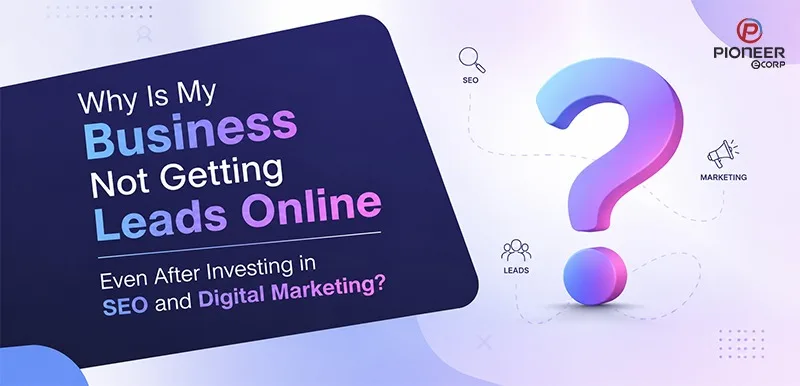
Your business is not getting leads — and you are not sure why. You have invested in SEO, your website is up and running, you are posting on social media, and maybe you have even run a few Google Ads. But the enquiries are not coming in the way you expected. If this is where you are right now, you are not alone — and more importantly, this is fixable.
We manage digital marketing for industrial and B2B businesses across Chennai and Tamil Nadu. And this is the single most common frustration we hear — from power rental companies, equipment dealers, and service businesses who have already spent money on digital but are not seeing results.
The good news: a business not getting leads despite being online almost always has clear, identifiable gaps. This blog walks through each one — with real-world examples from businesses in Chennai — so you can audit your own situation and take action today.
1. Your Website Looks Professional But Does Not Convert
A good-looking website and a lead-generating website are two completely different things. Most businesses invest in website development to get online — which is the right first step. But then the website sits there like a digital brochure, with no clear path to enquiry.
Consider this real scenario: an industrial power rental company with 25+ years of experience, a solid client list including MRF and Amazon, and pages for every product from diesel generators to air compressors and load banks — had a website with no WhatsApp button, no clickable phone number in the header, and a contact form buried two clicks deep. Every visitor who landed on a service page had to work to reach out. Most did not bother.
- A website that actively generates leads must have:
Website Conversion Must-Haves for B2B and Industrial Businesses
- WhatsApp Click-to-Chat Button: Keep a visible WhatsApp button fixed on every page for instant enquiries.
- Clickable Phone Number: Ensure visitors can call directly from both desktop and mobile devices.
- Simple Homepage Enquiry Form: Ask only for name, phone number, and requirement to maximize conversions.
- Clear Service Area: Mention your coverage area prominently, such as Chennai, Tamil Nadu, or Pan India.
- Trust Signals Above the Fold: Display client logos, testimonials, or certifications without requiring users to scroll.
- Fast Loading Speed: Keep page load times under 3 seconds to reduce visitor drop-offs and improve conversions.
2. Your SEO Is Bringing Visitors Who Will Never Buy
This is one of the most common reasons a business is not getting leads from SEO. Your rankings look good on paper, but the traffic is made up of people who are researching — not people who are ready to buy or rent.
Here is a concrete example: an industrial equipment company in Chennai ranking well for keywords like “types of air compressors” and “how forklifts work” was getting steady traffic — but the visitors were engineering students, not procurement managers. The moment the SEO focus shifted to terms like “ELGI air compressor dealers in Chennai” and “forklift rental for warehouse in Tamil Nadu,” the enquiries started coming in.
Traffic Keywords vs. Lead Keywords — Know the Difference
- Traffic: “Types of forklifts for warehouse” → Lead: “Electric forklift dealers in Chennai”
- Traffic: “How diesel generators work” → Lead: “Diesel generator rental in Ambattur Industrial Estate”
- Traffic: “Air compressor maintenance tips” → Lead: “ELGI screw compressor price in Chennai”
- Traffic: “What is a load bank” → Lead: “Rental load banks for generator testing Chennai”
3. Social Media Is Creating Brand Awareness, Not Enquiries
Social media marketing is one of the most misunderstood investments among B2B and industrial businesses in Tamil Nadu. The common mistake is posting product photos and company updates — and then wondering why the phone is not ringing.
For businesses like power equipment rental companies or industrial equipment dealers, social media marketing works when it is targeted at the right decision-makers with the right offer. A post about “diesel generator rental for events in Chennai” with a direct WhatsApp link will outperform ten generic product photos every single time.
Social Media Marketing That Actually Generates B2B Leads
- Meta Lead Ads with pre-filled forms — ideal for rental enquiries and dealer quotation requests.
- WhatsApp Click-to-Chat ads on Facebook and Instagram — one of the best-performing formats for industrial SMBs.
- Video posts showing your equipment in action at client sites — builds trust faster than generic promotional creatives.
- Retargeting ads for website visitors from the last 30 days — helps recover the 97% of visitors who leave without enquiring.
- Industry-specific audience targeting — procurement managers, plant heads, warehouse supervisors, and decision-makers across Tamil Nadu.
4. Your Digital Channels Are Not Connected Into a Funnel
Most businesses run SEO, social media, and a website as three separate activities. The result is that a visitor who finds you through Google but does not enquire immediately is gone forever — because there is no retargeting, no follow-up touchpoint, no connected funnel bringing them back.
A power rental or industrial equipment business in Chennai typically needs 3 to 5 touchpoints before a buyer picks up the phone. A connected funnel ensures those touchpoints happen automatically, without the business owner manually chasing anyone.
A Connected Lead Funnel for Industrial and B2B Businesses
- Step 1: Buyer searches “diesel generator rental Chennai” and lands on your SEO page.
- Step 2: The visitor does not enquire immediately, but Google Tag Manager records the visit.
- Step 3: The visitor sees your retargeting ad on Facebook or Instagram the next day.
- Step 4: They click the ad and land on a focused landing page with a short form and WhatsApp button.
- Step 5: They submit an enquiry and receive an instant WhatsApp confirmation while your team follows up quickly.
5. Your Google Business Profile Is Inactive or Incomplete
For businesses operating out of specific locations in Chennai or Tamil Nadu, Google Maps is often where the first buyer-intent search happens. “Generator rental near me,” “air compressor dealers in Chennai,” “forklift supplier in Ayanambakkam” — these are high-intent searches that your Google Business Profile should be capturing.
The reality is that most industrial and equipment businesses have a GBP listing that was set up once and never touched again. No weekly posts, no updated photos, no responses to reviews. Google deprioritises inactive listings — and a competitor with a more active profile will rank above you on the map, even if you have been in business longer.
Google Business Profile Checklist for Industrial Businesses
- Choose the right business category — use “Generator Dealer”, “Industrial Equipment Supplier”, or the most relevant primary category.
- List all products and services — include descriptions, specifications, and pricing where possible.
- Collect and respond to reviews — aim for at least 10 quality reviews and reply to every one.
- Publish weekly Google Posts — share rental offers, new arrivals, project updates, and industry news.
- Update photos regularly — showcase equipment, facilities, team members, and completed installations.
- Set accurate service areas — include all cities, districts, and industrial zones you actively serve.
6. Enquiries Are Coming In — But Getting Lost Before Follow-Up
Here is the gap that no digital marketing agency will tell you about: sometimes the lead generation is working, but the follow-up process is broken. Enquiries are coming in through WhatsApp, the website form, or missed calls — but nobody is picking them up fast enough.
In the industrial and equipment sector, buyers are often comparing 3 to 4 vendors at the same time. The first company to respond with a price or call-back gets the deal. A procurement manager looking for a 200 kVA generator rental in Chennai on a Tuesday afternoon will not wait until Thursday morning for your call.
Lead Response Process That Prevents Drop-Off
- Set up an instant WhatsApp auto-reply — acknowledge every enquiry within 30 seconds and set clear expectations for a callback.
- Implement a missed-call callback rule — return every missed call within 10 minutes.
- Assign a dedicated enquiry owner — one person should manage all website, WhatsApp, and phone enquiries during business hours.
- Follow a structured follow-up sequence — Call at Hour 1, WhatsApp at Hour 24, and follow up again at Hour 72.
- Track every lead in one place — record Lead Name, Source, Date, Status, and Next Action in a CRM or spreadsheet.
What You Should Do Right Now
If your business is not getting leads despite ongoing digital marketing investment, do not increase the budget yet. Start with an honest audit across these six areas:
Quick Lead Generation Audit Checklist
- Website Conversion: Is your website equipped with a WhatsApp button, clickable phone number, and a simple homepage enquiry form?
- SEO Strategy: Are your target keywords buyer-intent and location-specific rather than purely informational?
- Social Media Marketing: Are you running lead generation campaigns instead of only posting brand awareness content?
- Retargeting Funnel: Are your website, social media, and advertising channels connected into a lead nurturing funnel?
- Google Business Profile: Is your profile active with recent posts, updated photos, and customer engagement?
- Lead Follow-Up: Can your team respond to new enquiries within 30 minutes or less?
Fixing even two or three of these gaps consistently produces a visible change in enquiries within 30 to 60 days — without increasing your ad spend.
We have worked with B2B and industrial businesses in Chennai to go from zero online enquiries to 30 to 50 qualified leads per month by addressing exactly these issues. Companies with decades of experience and strong reputations — like power rental providers serving enterprise clients, or equipment manufacturers with 1,000+ installations across India — often have the credibility, but the digital channel is simply not set up to capture demand that is already there.
The problem is never a lack of investment. It is almost always a matter of strategy, structure, and follow-through.