

Introduction
In 2026, launching a website is easier than ever—but building a successful online business is harder than ever.
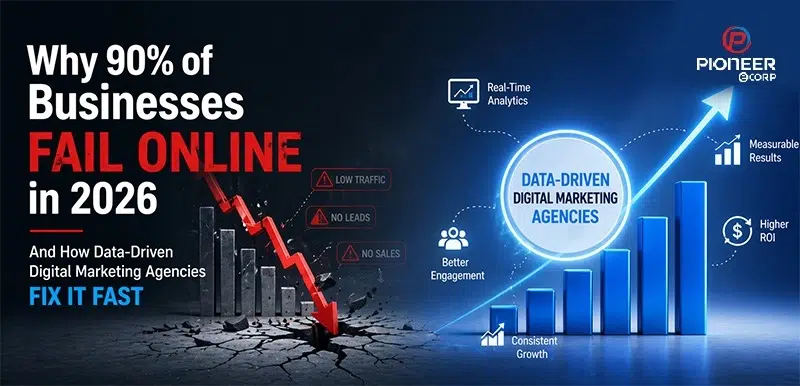
Thousands of businesses go live every day. Yet, nearly 90% of them fail within the first year.
The reason isn’t bad products. It’s a bad strategy.
This article breaks down why businesses fail online and how data-driven digital marketing agencies turn struggling brands into high-performing revenue machines—fast.
The Reality of Online Business Failure in 2026
The digital space is brutally competitive.
- Over 2 billion websites exist
- Millions compete for the same keywords
- Attention spans are shorter than ever
Without a clear strategy, your business becomes invisible.
Most businesses fail not because of effort—but because of lack of direction and data.
Top Reasons Why Businesses Fail Online
1. No Clear Digital Strategy
Many businesses jump into:
- Website creation
- Social media posting
- Running ads
But without a goal-driven strategy, everything becomes random.
Result: No traffic, no leads, no growth.
2. Poor SEO Execution
SEO in 2026 is not just keywords.
It requires:
- Search intent optimization
- Content depth
- Internal linking
- Technical SEO
Businesses that ignore this never rank on Google.
3. Weak Website Experience
If it has:
- Slow loading speed
- Poor design
- Confusing navigation
Visitors leave within seconds.
This increases bounce rate and kills conversions.
4. No Data-Driven Decisions
Most businesses rely on:
- Guesswork
- Assumptions
- “What feels right”
But in 2026, marketing runs on data, not opinions.
5. Ignoring Conversion Optimization
Traffic alone doesn’t matter.
If your website doesn’t convert visitors into:
- Leads
- Calls
- Sales
Then all efforts are wasted.
What Is Data-Driven Digital Marketing?
Data-driven marketing means:
Every decision is backed by real user data
This includes:
- Search behavior
- User clicks
- Heatmaps
- Conversion tracking
- Audience insights
Instead of guessing, agencies analyze and optimize continuously.
How Data-Driven Agencies Fix Problems Fast
1. SEO & Search Visibility
Agencies fix SEO by:
- Identifying high-intent keywords
- Optimizing content structure
- Fixing technical issues
- Building topical authority
Result: Higher rankings, more organic traffic
2. Performance Marketing (Paid Ads)
They don’t waste money on ads.Instead, they:
- Target the right audience
- Test multiple creatives
- Optimize based on ROI
Result: Faster lead generation
3. Conversion Rate Optimization (CRO)
Agencies improve:
- Landing pages
- Call-to-actions
- User journey
Even a 1% increase in conversion can double revenue.
4. Analytics & Tracking
They track everything:
- User behavior
- Traffic sources
- Conversion paths
Tools like dashboards help identify:
- What’s working
- What’s failing
Step-by-Step Growth Framework Used by Agencies
- Audit – Website, SEO, ads, content
- Research – Keywords, competitors, audience
- Strategy – Clear roadmap for growth
- Execution – SEO + ads + content
- Optimization – Continuous improvement
- Scaling – Increase ROI and revenue
Real-World Example
A business struggling with:
- No traffic
- Low leads
After implementing a data-driven strategy:
- SEO traffic increased by 300%
- Leads improved by 5X
- Cost per lead reduced by 40%
👉 This is the power of data-driven marketing.
Tools & Technologies Used by Agencies
Top agencies rely on:
- Analytics platforms
- SEO tools
- Heatmap tracking tools
- Ad optimization platforms
These tools help make smart, fast decisions.
Future Trends in Digital Marketing (2026 & Beyond)
- AI-driven personalization
- Voice search optimization
- Hyper-targeted ads
- First-party data strategies
Businesses that adapt will dominate.
People Also Ask (PAA)
Final Thoughts
In 2026, success online is not about working harder—it’s about working smarter.
Businesses that rely on:
- Guesswork
- Random strategies
- Outdated methods
Will fail.
But those that use:
- Data
- Analytics
- Strategic execution
Will scale faster than ever.
The difference is clear:
Data-driven digital marketing is no longer optional—it’s essential.