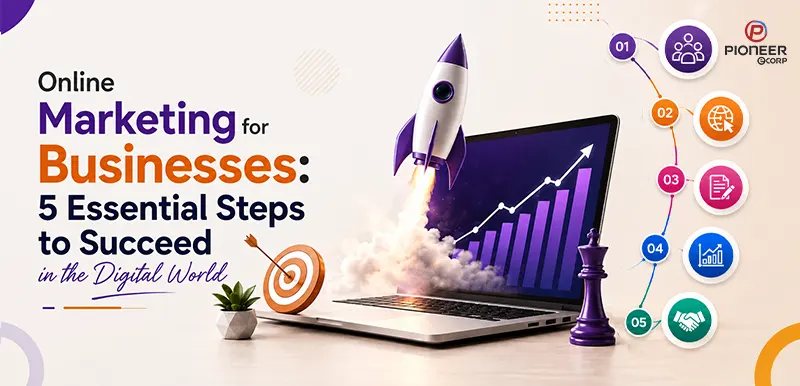
Online Marketing for Businesses: 5 Essential Steps to Succeed in the Digital World
Online Marketing for Businesses has become a key part of reaching customers, building brand visibility, and generating consistent business opportunities. As more people search, compare, and purchase online, businesses need a clear strategy to stay visible where their customers are looking.
A successful online presence is not built through one channel alone. It requires a combination of the right platforms, useful content, customer-focused messaging, and continuous performance analysis.
Table of Contents
- Build a Professional Online Presence
- Understand Your Target Audience
- Strengthen Your Search Visibility
- Connect With Customers Through Social Media
- Turn Online Visitors Into Qualified Leads
- Frequently Asked Questions
- Conclusion
1. Build a Professional Online Presence
The first step in online marketing for businesses is creating a strong digital foundation. Your website is often the first interaction a potential customer has with your brand, so it needs to create a positive impression quickly.
A professional website should clearly explain what your business offers and why customers should choose you. Important information should be easy to find, including your services, products, contact details, location, and enquiry options.
Your website should also be:
- Mobile-friendly
- Fast and easy to navigate
- Secure and reliable
- Simple to understand
- Designed with clear calls to action
For example, a company offering industrial equipment should create dedicated service or product pages rather than placing all information on one general page. This makes it easier for visitors to find exactly what they need.
A strong digital presence also extends beyond your website. Business directories, local listings, review platforms, and other relevant online profiles can help customers discover and evaluate your company.
Ready to Grow Your Business Online?
Build a stronger digital presence with a strategy designed around your business goals.
2. Understand Your Target Audience
No marketing strategy can work effectively without knowing who you are trying to reach. Businesses should understand their customers before deciding what content to create or where to promote it.
Start by identifying your ideal customers and their requirements. Consider their location, industry, interests, challenges, purchasing behaviour, and common questions.
Keyword research is particularly useful because it shows what people are actively searching for. A customer looking for an immediate service has different intent from someone researching a topic for the first time.
For example, a person searching for “commercial generator rental” may already be looking for a provider, while someone searching for “how does a diesel generator work” may only be gathering information.
Understanding these differences helps businesses create content that matches different stages of the customer journey.
A useful audience research process includes:
- Identifying your ideal customer
- Studying customer problems and needs
- Researching relevant search terms
- Analysing competitor positioning
- Understanding purchasing decisions
- Creating content around customer questions
The more accurately you understand your audience, the easier it becomes to create marketing messages that attract the right people.
3. Strengthen Your Search Visibility
Search engines play an important role in how customers discover businesses. When people need a product, service, or solution, they often begin with a search.
This is where a professional SEO service can help businesses improve their organic visibility and attract relevant visitors.
SEO involves much more than inserting keywords into website content. A well-planned strategy can include technical improvements, content optimization, internal linking, local SEO, website structure, and user experience.
Businesses should focus on creating pages that genuinely answer what users are looking for.
For example, a company selling medical furniture could create separate pages for hospital beds, patient waiting chairs, examination tables, and other products. Each page can target a specific search intent and provide detailed information for potential buyers.
Content should also be updated when information becomes outdated. Search trends, customer expectations, and competitors can change over time, so maintaining existing pages is just as important as creating new ones.
A consistent SEO strategy can help businesses:
- Improve organic visibility
- Attract relevant search traffic
- Build authority within their industry
- Reach customers with specific needs
- Generate long-term website opportunities
SEO is not an overnight solution. Results depend on competition, website quality, content, authority, and the consistency of optimization efforts.
4. Connect With Customers Through Social Media
Social platforms give businesses an opportunity to communicate directly with their audience and build familiarity around their brand.
Social media marketing can be particularly useful for businesses that want to showcase products, share expertise, educate customers, and encourage conversations.
However, businesses do not need to be active on every platform. The better approach is to identify where their target audience spends time and build content specifically for those channels.
Different types of content can serve different purposes:
- Educational posts can demonstrate expertise.
- Product videos can explain features and benefits.
- Customer stories can build trust.
- Short-form videos can increase reach.
- Industry updates can keep followers informed.
- Behind-the-scenes content can make a brand more relatable.
For example, a B2B company may use LinkedIn to share industry insights, case studies, and professional content. A consumer brand may find visual platforms more effective for product demonstrations and promotional content.
The objective should not simply be gaining followers. Businesses should focus on meaningful engagement, website visits, enquiries, brand awareness, and customer relationships.
5. Turn Online Visitors Into Qualified Leads
Attracting visitors is only one part of digital growth. Businesses also need to give those visitors a clear reason and opportunity to take the next step.
This is where lead generation becomes important.
A visitor who finds your website should be able to understand your offering and contact your business without unnecessary effort. Clear calls to action can encourage visitors to request information, schedule a consultation, call the business, or submit an enquiry.
Common lead-generation methods include:
- Contact forms
- WhatsApp enquiry buttons
- Phone call options
- Service-specific landing pages
- Consultation forms
- Email campaigns
- Downloadable resources
- Online advertising
The quality of the landing page matters. If an advertisement promises information about a particular service but sends users to a generic homepage, the visitor may leave without taking action.
Businesses should also measure what happens after visitors arrive.
Important performance indicators include:
- Website conversions
- Enquiry volume
- Conversion rate
- Cost per lead
- Qualified leads
- Customer acquisition cost
- Revenue generated from campaigns
For example, if a website receives thousands of visitors but very few enquiries, simply increasing traffic may not solve the problem. The business may need to improve its content, offer, page design, trust signals, or calls to action.
Creating a Sustainable Digital Strategy
The five steps above should not operate independently. They work best as parts of one connected strategy.
Start with a strong website and understand the audience you want to reach. Build search visibility by creating useful, optimized content. Use social platforms to communicate with your audience and strengthen brand awareness. Finally, create clear conversion paths that turn interested visitors into enquiries and customers.
Digital marketing should also be treated as an ongoing process rather than a one-time campaign. Businesses should regularly review performance and identify what is working and what needs improvement.
A monthly review can examine:
- Website traffic
- Search performance
- Content engagement
- Social media results
- Enquiry trends
- Conversion rates
- Marketing costs
This data helps businesses make decisions based on actual performance rather than assumptions.
Frequently Asked Questions
What is online marketing for businesses?
Online marketing for businesses involves promoting products, services, or brands through digital channels such as websites, search engines, social platforms, email, and online advertising. The goal is to reach potential customers and support business growth.
Why is an online presence important for a business?
Customers increasingly research businesses online before making purchasing decisions. A professional online presence helps a company establish credibility, provide useful information, and make it easier for potential customers to contact the business.
How can SEO help a small business?
SEO can help small businesses improve their visibility when potential customers search for relevant products or services. A focused strategy can help them compete for specific, valuable search terms without relying entirely on paid advertising.
Which social media platform is best for businesses?
There is no single best platform for every business. The right choice depends on the target audience, industry, content type, and business goals. Companies should prioritize platforms where their potential customers are most active.
How can a business generate more online enquiries?
Businesses can improve enquiries by targeting relevant audiences, creating useful landing pages, adding clear calls to action, improving website usability, and testing different marketing channels. Tracking conversions can help identify which strategies generate the most valuable leads.
Conclusion
Online Marketing for Businesses is most effective when it focuses on the complete customer journey rather than individual marketing activities.
A professional online presence creates the foundation. Audience research helps businesses understand what customers need. Search optimization improves visibility, social platforms build engagement, and effective conversion strategies turn online interest into business opportunities.
The key is consistency. Businesses that continuously improve their website, content, search visibility, customer communication, and conversion process are better positioned to build a stronger digital presence and achieve sustainable growth.
Ready to Take Your Online Marketing to the Next Level?
Connect with our team and create a digital marketing strategy that supports your business growth.
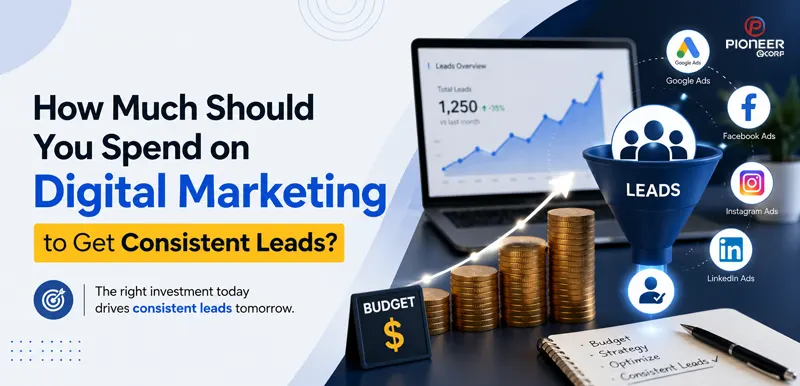
How Much Should You Spend on Digital Marketing to Get Consistent Leads?
Digital Marketing to Get Consistent Leads is not about spending the biggest budget. It is about investing the right amount in the right channels, measuring results, and improving campaigns based on what actually generates leads.
For small businesses, startups, and growing companies, the biggest question is simple: How much should you spend on digital marketing each month to generate a consistent flow of qualified leads?
The answer depends on your industry, target audience, competition, location, sales cycle, and business goals. However, having a practical budget framework makes the decision much easier.
Table of Contents
- How Much Should You Spend on Digital Marketing?
- What Determines Your Digital Marketing Budget?
- Recommended Digital Marketing Budget by Business Size
- Where Should You Spend Your Marketing Budget?
- Example: Building a Monthly Lead Generation Budget
- How to Know If Your Budget Is Working
- Common Digital Marketing Budget Mistakes
- FAQs
- Conclusion
How Much Should You Spend on Digital Marketing?
There is no universal amount that works for every business. A company selling high-value services may need to spend more per lead than a business selling low-cost products.
As a starting point, many businesses can divide their monthly marketing investment approximately like this:
- Starter businesses: ₹15,000–₹30,000 per month
- Growing businesses: ₹30,000–₹75,000 per month
- Established businesses: ₹75,000–₹2,00,000+ per month
These are practical starting ranges, not fixed rules.
Your actual budget should be based on how much a customer is worth to your business and how much you can reasonably spend to acquire that customer.
For example, if one customer generates ₹1,00,000 in revenue, spending ₹5,000 to acquire that customer may be reasonable. If a customer generates only ₹5,000, the same acquisition cost could be unsustainable.
What Determines Your Digital Marketing Budget?
Before choosing a number, consider these factors.
1. Your Business Revenue and Growth Target
Your budget should support a specific business objective.
For example, suppose your company currently generates 20 leads per month and wants to reach 50. You need to determine:
- How many additional leads are required?
- How many leads usually become customers?
- What is your average customer value?
- How much can you afford to spend to acquire each customer?
This gives you a more realistic budget than simply choosing an arbitrary monthly amount.
2. Industry Competition
Competition directly affects marketing costs.
A local business targeting a low-competition keyword may generate organic traffic with relatively limited investment. A company competing for highly competitive keywords may need stronger SEO, content, advertising, and website optimization.
The same applies to paid advertising. Competitive industries often have higher costs per click and higher costs per lead.
3. Your Target Audience
Your audience determines where your budget should go.
If your customers actively search Google for your services, SEO and search advertising may be valuable.
If your audience discovers products through Instagram or Facebook, social media marketing may deserve a larger share of your budget.
The goal isn’t to be everywhere. It is to invest where your potential customers actually spend time.
Recommended Digital Marketing Budget by Business Size
Small Businesses
A small business can start with around ₹15,000–₹30,000 per month.
A possible allocation could include:
- SEO and content: ₹8,000
- Social media: ₹5,000
- Paid advertising: ₹10,000
- Tracking and optimization: ₹2,000
The exact split should change according to performance.
Growing Businesses
Businesses that already have some traction can consider ₹30,000–₹75,000 per month.
At this stage, you can invest in multiple channels and identify which ones consistently produce qualified leads.
For example:
- SEO and content marketing
- Google Ads
- Social media marketing
- Landing page optimization
- Email campaigns
- Conversion tracking
Established Businesses
Companies with predictable sales and stronger customer value may invest ₹75,000–₹2,00,000 or more per month.
The focus should shift from simply generating leads to improving lead quality, conversion rates, customer acquisition cost, and return on investment.
Where Should You Spend Your Marketing Budget?
Don’t divide your budget equally between every marketing channel. That’s usually a waste.
Instead, prioritize channels based on customer behavior.
SEO
SEO can help businesses generate long-term organic traffic. It generally takes longer than paid advertising but can continue generating traffic after the initial work is completed.
Your SEO budget may cover:
- Keyword research
- On-page optimization
- Technical SEO
- Content creation
- Internal linking
- Local SEO
- Link building
Paid Advertising
Paid advertising can generate traffic and leads faster.
However, advertising costs don’t stop when you stop spending. That’s why paid campaigns should be measured carefully.
Track:
- Cost per click
- Cost per lead
- Conversion rate
- Qualified leads
- Customer acquisition cost
Content Marketing
Content marketing supports both SEO and lead generation.
Useful content can include:
- Blog posts
- Case studies
- Guides
- Comparison pages
- Videos
- Landing page content
- Industry-specific resources
The objective should not be producing content simply to increase the number of pages on your website. Content should answer real customer questions and move potential buyers closer to taking action.
Website Development and Conversion Optimization
Driving traffic to a poorly designed website is a common mistake.
Your website should make it easy for visitors to:
- Understand your service
- Trust your business
- Find relevant information
- Contact you
- Request a quote
- Book a consultation
Even a small improvement in conversion rate can significantly increase the number of leads generated from the same traffic.
Example: Building a Monthly Lead Generation Budget
Suppose a B2B company wants 30 qualified leads per month.
Its initial monthly budget could be:
Total: ₹60,000
- SEO and content marketing: ₹20,000
- Google Ads: ₹25,000
- Social media marketing: ₹7,000
- Landing page and conversion optimization: ₹5,000
- Testing and analytics: ₹3,000
After three months, the company reviews the data.
If SEO generates 15 qualified leads, paid advertising generates 10, and social media generates only 2, the company shouldn’t automatically continue spending the same amount on every channel.
It should analyze lead quality and customer conversion, not just lead volume.
How to Know If Your Budget Is Working
Spending more money doesn’t automatically produce better results.
Track these metrics every month:
Cost Per Lead (CPL)
Total marketing spend ÷ number of leads
Customer Acquisition Cost (CAC)
Total marketing and sales costs ÷ number of new customers
Lead-to-Customer Conversion Rate
Customers ÷ qualified leads × 100
Return on Investment (ROI)
Revenue generated compared with marketing investment
For example, spending ₹50,000 and generating 100 low-quality leads isn’t necessarily better than spending ₹50,000 and generating 30 highly qualified leads.
Lead quality matters more than lead quantity.
Common Digital Marketing Budget Mistakes
Avoid these mistakes when planning your marketing investment:
- Spending money without defining a lead target
- Using every marketing channel at once
- Increasing ad spend before fixing conversion problems
- Ignoring SEO because it takes time
- Measuring clicks instead of qualified leads
- Changing campaigns too frequently
- Failing to track where leads come from
- Sending paid traffic to weak landing pages
- Focusing only on lead volume instead of sales
A consistent lead generation strategy requires patience, tracking, and continuous optimization.
Frequently Asked Questions
Conclusion
There is no magic number for Digital Marketing to Get Consistent Leads. A ₹20,000 monthly budget can work for one business and be completely inadequate for another.
The smarter approach is to start with a realistic budget, establish measurable goals, track qualified leads, and increase investment in channels that consistently produce profitable customers.
Use SEO and content marketing to build long-term visibility, paid advertising when faster results are needed, social media marketing where your audience is active, and website optimization to convert traffic into enquiries.
Don’t ask, “How much should I spend?” Ask, “How much can I profitably spend to acquire one customer?”
That is the number that should ultimately drive your digital marketing budget.
Top 10 Digital Marketing Strategies to Grow Your Business
Every business owner wants more customers, more sales, and a good reputation online. Digital marketing is the tool that makes this possible. In this blog, we’ll go through the top 10 digital marketing strategies in plain, simple language — no confusing terms, just ideas you can actually use for your business.
You don’t need a big team or a huge budget to get started. You just need to know which steps matter most. Here’s a simple walk-through of each one.
1. Help Customers Find You When They Search
When someone searches for something your business sells, you want to show up. This is called SEO, and in simple words, it just means making your website easy for Google to understand and easy for people to find.
- Use the same words your customers would type in Google
- Keep each page title short and to the point
- Make sure your website opens fast, especially on mobile
- Try to get other trusted websites to mention or link to you
Example: If you own a bakery, and someone searches “fresh bread near me,” good SEO helps your bakery show up in that search.
2. Share Useful Content, Not Just Ads
People trust businesses that teach them something useful, not just businesses that keep asking them to buy. This is content marketing — sharing blogs, videos, or tips that help your customers.
- Answer the questions your customers ask most
- Record quick videos demonstrating your product in action
- Share real stories of happy customers
- Keep your old posts updated instead of leaving them outdated
When you help people first, they trust you more when it’s time to buy.
3. Be Active on Social Media
Your customers are already on Facebook, Instagram, or WhatsApp every day. So your business should be there too — not to sell every post, but to connect.
- Post regularly, even if it’s simple content
- Share a mix of offers, tips, and behind-the-scenes moments
- Try short videos — they get seen the most
- Reply to comments and messages quickly
Example: A furniture shop posting a quick “before and after” video of a room makeover usually gets more attention than just a product photo.
4. Collect Leads, Not Just Visitors
A visitor who leaves your website without giving their number or email is a missed chance. This step is about turning visitors into people you can follow up with.
- Offer something free, like a discount or a helpful guide, in exchange for their contact details
- Keep your contact form short — name and phone number is often enough
- Follow up with people who show interest but don’t buy right away
The goal here is simple: don’t let interested people slip away.
5. Keep Your Website Simple and Fast
Think of your website as your store’s entrance. If it’s slow or confusing, people leave before they even see what you offer.
- Keep the menu simple — don’t make people search for what they need
- Check that it runs smoothly on mobile, where most visitors land
- Include obvious action buttons such as “Call Now” or “Order Now”
- Remove any extra steps that make buying or contacting harder
A clean, fast website makes everything else — your ads, your posts, your content — work better.
6. Try Paid Ads for Faster Results
While SEO and content take time to grow, paid ads can bring in customers almost immediately. Google Ads and Facebook Ads let you show your business to the exact people who are likely to buy.
- Start small and see what works before spending more
- Show ads again to people who already visited your website
- Keep an eye on how much each customer is costing you
- Change your ad if it’s not working, don’t just keep running it
7. Use Email to Stay Connected
Email might feel old-fashioned, but it still works well. It’s a direct way to reach your customers without depending on social media algorithms.
- Send a simple welcome message to new customers
- Share helpful tips sometimes, not just discounts
- Group your customers based on what they’re interested in
- Try different subject lines to see what people open more
A good email, sent at the right time, can bring a customer back to buy again.
8. Ask for Reviews and Keep Your Listing Updated
Before buying, most people check reviews first. This step costs nothing, but it builds trust fast.
- Ask happy customers to leave a review on Google
- Keep your business hours, address, and phone number accurate everywhere
- Reply politely to every review, good or bad
- Add clear photos of your shop, products, or team
9. Check What's Working and What's Not
You don’t need to guess — the numbers will tell you what’s working. This just means keeping an eye on simple things like how many people visit your site and how many actually buy or contact you.
- See where most of your visitors are coming from
- Notice which posts or ads bring the most attention
- Drop what isn’t working and do more of what is
- Review this once a month, it doesn’t need to be daily
10. Team Up with Others
You don’t have to grow alone. Working with other businesses or local influencers can introduce you to new customers faster.
- Partner with a business that serves the same customers as you, in a different way
- Work with small local influencers who genuinely like your product
- Write a guest post for another website in your industry
- Share each other’s posts to reach new people
Putting It All Together
You don’t have to do all ten things at once. Start with one or two — maybe getting found on Google and being active on social media — and build from there. Slowly adding these strategies over time will help your business grow steadily, without feeling overwhelming.
If handling all this on top of running your business feels like too much, that’s exactly the kind of work an agency like Pioneer Ecorp takes off your plate. Based in Chennai, Pioneer Ecorp works with businesses across industries — from manufacturing to retail — helping them get found online, attract the right customers, and turn that attention into real sales. Whether you need help with just one of these strategies or a complete digital marketing plan, having the right team in your corner makes growth a lot less overwhelming.
Frequently Asked Questions
1. Which strategy should I start with if I’m just beginning?
Start with your website and social media. These are the easiest channels to manage, require a small budget, and create a strong foundation for your future digital marketing efforts.
2. How long before I see results?
Some strategies, such as paid advertising, can begin generating traffic within a few days. SEO takes longer, usually several months, but it provides more sustainable long-term growth.
3. Do I need to hire an expert for all of this?
Not necessarily. Many activities, including posting on social media, updating your website, and encouraging customer reviews, can be handled by you or your team. As your business grows, you can consider working with professionals for advanced strategies.
4. How often should I post on social media?
Consistency is more important than frequency. Posting three or four quality updates each week is generally more effective than posting every day for a short period and then becoming inactive.
5. Is it expensive to start digital marketing?
No. Many effective digital marketing activities, such as creating helpful content, optimizing your Google Business Profile, and collecting customer reviews, require little or no investment. Paid advertising can be introduced later as your budget grows.
Top 10 SEO Strategies to Increase Organic Traffic
Top 10 SEO Strategies to grow your website, you’re in the right place. Whether you’re a business owner, marketer, or part of an SEO Company, applying the right SEO techniques can significantly improve your organic traffic, search rankings, and online visibility. When combined with digital marketing and a strong website development company, these strategies create long-term business growth.
Why SEO Still Matters in 2026
Search Engine Optimization (SEO) is one of the most cost-effective ways to attract qualified visitors to your website. Unlike paid advertisements that stop generating traffic once your budget runs out, SEO continues delivering results over time.
Benefits of SEO include:
- Higher organic traffic
- Better brand visibility
- Increased website credibility
- More qualified leads
- Higher conversion rates
- Long-term return on investment
Businesses that consistently invest in SEO often outperform competitors who rely only on paid advertising.
Top 10 SEO Strategies to Increase Organic Traffic
1. Focus on User Search Intent
Ranking for keywords alone is no longer enough. Google prioritizes content that satisfies what users are actually searching for.
Before creating content, ask:
- Is the user looking for information?
- Are they comparing products?
- Do they want to buy a service?
- Are they searching for a local business?
For example, someone searching “best SEO Company” expects comparisons, reviews, and expertise—not just a sales page.
Matching user intent improves:
- Rankings
- Time on page
- Conversion rate
- User experience
2. Perform Keyword Research the Right Way
Successful SEO starts with understanding what your audience searches for.
Target a mix of:
- Primary keywords
- Long-tail keywords
- Location-based keywords
- Question keywords
- Low-competition opportunities
Instead of targeting only highly competitive keywords, focus on specific phrases that have clear buying intent.
Useful keyword research tools include:
- Google Keyword Planner
- Google Search Console
- Ahrefs
- SEMrush
- Ubersuggest
Remember, quality keywords are more valuable than simply targeting high search volume.
3. Publish High-Quality Content Consistently
Google rewards websites that provide useful, original, and comprehensive content.
Your content should:
- Solve user problems
- Answer common questions
- Include practical examples
- Be easy to read
- Stay updated regularly
Avoid creating content just to fill pages. Every article should provide genuine value.
A strong content strategy also supports your overall digital marketing efforts by driving traffic through blogs, guides, case studies, and educational resources.
4. Optimize Every On-Page SEO Element
Even excellent content can struggle without proper on-page optimization.
Ensure every page includes:
- Optimized title tag
- Meta description
- Proper H1 heading
- H2 and H3 subheadings
- Keyword naturally placed throughout the content
- Image ALT text
- Internal links
- SEO-friendly URLs
These elements help search engines understand your page while improving user experience.
5. Improve Website Speed and Core Web Vitals
Website speed is an important ranking factor.
Slow-loading websites often experience:
- Higher bounce rates
- Lower rankings
- Poor user engagement
- Reduced conversions
Ways to improve website speed:
- Compress images
- Enable browser caching
- Minify CSS and JavaScript
- Use lazy loading
- Choose reliable hosting
- Optimize database performance
A professional website development company can build a technically optimized website that performs well across desktop and mobile devices.
6. Build High-Quality Backlinks
Backlinks remain one of Google’s strongest ranking signals.
Instead of chasing hundreds of low-quality links, focus on earning backlinks from trusted websites.
Effective backlink strategies include:
- Guest blogging
- Digital PR
- Publishing research
- Creating valuable guides
- Industry partnerships
- Resource page outreach
Quality always outweighs quantity when building backlinks.
7. Strengthen Technical SEO
Technical SEO ensures search engines can properly crawl and index your website.
Important technical SEO tasks include:
- XML Sitemap optimization
- Robots.txt configuration
- Fix broken links
- Canonical tags
- HTTPS security
- Structured Schema Markup
- Mobile optimization
- Crawl error fixes
Technical improvements often produce significant ranking gains, especially for larger websites.
8. Optimize for Local SEO
If your business serves a specific location, Local SEO should be part of your strategy.
Important Local SEO activities include:
- Optimize your Google Business Profile
- Collect customer reviews
- Build local citations
- Use location-based keywords
- Maintain NAP consistency (Name, Address, Phone Number)
For businesses such as restaurants, hospitals, agencies, or service providers, Local SEO can generate highly targeted traffic.
9. Create a Strong Internal Linking Structure
Internal links help search engines understand your website hierarchy while guiding visitors toward relevant pages.
Good internal linking:
- Improves crawlability
- Distributes page authority
- Increases user engagement
- Reduces bounce rate
- Helps important pages rank better
For example, a blog discussing SEO can naturally link to service pages for SEO audits, content marketing, or technical optimization.
A well-planned internal linking strategy strengthens your entire website rather than individual pages.
10. Measure, Analyze, and Improve Continuously
SEO is never a one-time task.
Monitor your website regularly using:
- Google Analytics 4
- Google Search Console
- Ahrefs
- SEMrush
- Bing Webmaster Tools
Track important metrics such as:
- Organic traffic
- Keyword rankings
- Click-through rate (CTR)
- Bounce rate
- Conversion rate
- Indexed pages
Regular analysis helps identify opportunities and resolve issues before they affect rankings.
Common SEO Mistakes to Avoid
Many websites struggle because they repeat common SEO mistakes.
Avoid these issues:
- Keyword stuffing
- Duplicate content
- Thin content
- Slow-loading pages
- Broken internal links
- Ignoring mobile optimization
- Missing meta descriptions
- Poor website architecture
- Low-quality backlinks
- Publishing content without updating it
Fixing these problems often produces noticeable improvements in organic traffic.
Frequently Asked Questions
1. What are the Top 10 SEO Strategies for increasing organic traffic?
The most effective strategies include keyword research, creating high-quality content, improving website speed, strengthening technical SEO, building quality backlinks, optimizing for user intent, implementing Local SEO, improving internal linking, optimizing on-page SEO elements, and continuously monitoring website performance.
2. How long does SEO take to show results?
SEO is a long-term strategy. Most websites begin seeing noticeable improvements within 3 to 6 months. However, highly competitive industries may require additional time depending on competition, website authority, and the consistency of SEO efforts.
3. Why is content important for SEO?
High-quality content helps search engines understand your expertise while providing valuable information to users. It improves engagement, increases time spent on your website, attracts natural backlinks, and supports better search engine rankings.
4. Can a website development company help with SEO?
Yes. A professional website development company can build a fast, secure, mobile-friendly, and search engine optimized website. Proper website structure, speed optimization, and technical SEO all contribute to better search rankings and user experience.
5. Should I hire an SEO Company?
Hiring an experienced SEO Company gives you access to professional expertise in keyword research, technical SEO, content optimization, link building, and performance analysis. This helps improve organic visibility and supports long-term business growth.
Final Thoughts
Implementing these Top 10 SEO Strategies can help businesses attract more qualified visitors, improve search rankings, and build long-term online visibility. SEO is not about shortcuts or quick wins—it requires consistent optimization, valuable content, technical improvements, and ongoing analysis.
Whether you’re a startup, an established SEO Company, or a business investing in digital marketing, combining these proven SEO strategies with a professionally built website from an experienced website development company creates a strong foundation for sustainable growth. Focus on delivering value to users, maintaining technical excellence, and continually refining your strategy to stay ahead of changing search engine algorithms.
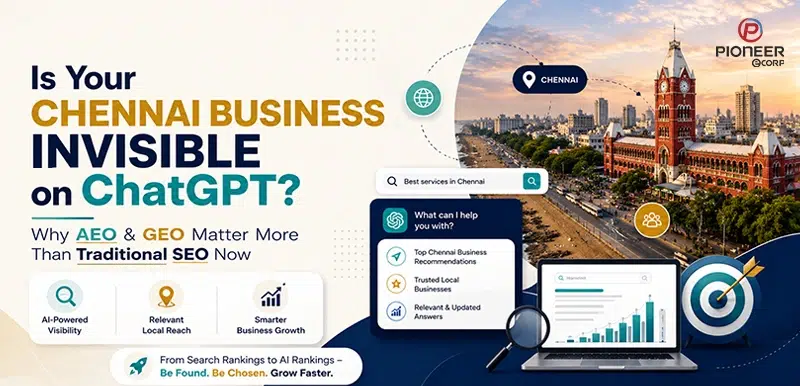
Is Your Chennai Business Invisible on ChatGPT? Why AEO & GEO Matter More Than Traditional SEO Now
Ask ChatGPT to recommend a digital marketing agency in Chennai, and it will answer confidently — with or without your business in the list.
That’s the uncomfortable part. AI platforms don’t wait for you to claim a listing or bid on an ad slot. They pull from whatever’s already indexed, structured, and trusted across the web.
If your site isn’t built for that, you simply don’t come up. Not low-ranked — invisible.
This is the gap between traditional SEO and what’s now called AEO (Answer Engine Optimization) and GEO (Generative Engine Optimization).
What's Covered
- ➜ What changed in how people search
- ➜ SEO vs AEO vs GEO — the real difference
- ➜ Why this matters for Chennai businesses specifically
- ➜ How AI platforms decide who gets mentioned
- ➜ Quick checks for AI visibility
- ➜ How to optimize for AEO & GEO
- ➜ Why choose Pioneer eCorp
- ➜ People also ask
What Changed: How People Actually Search Now
A few years ago, “search” meant typing a phrase into Google and scrolling through ten blue links.
Today, a growing number of people ask a question once, get a direct answer, and never click through to a website at all.
When someone asks an AI platform which is the best digital marketing agency in Chennai, the model doesn’t run a live search — it draws on patterns from content it has already ingested and trusts.
SEO vs AEO vs GEO — What's the Difference?
These three terms get used interchangeably, but they solve different problems.
Traditional SEO
Optimizes for search engine result pages — ranking a page higher so a human clicks the link.
Answer Engine Optimization (AEO)
Optimizes content to be the direct answer pulled into a featured snippet, voice reply, or chatbot response — not just a ranked link.
Generative Engine Optimization (GEO)
Focuses on being cited or referenced by name inside an AI-generated response, across platforms like ChatGPT, Gemini, and Perplexity.
Why This Matters for Chennai Businesses Specifically
Chennai’s digital marketing, IT services, and e-commerce sectors are unusually crowded.
A local buyer comparing options increasingly types a conversational question into an AI tool rather than a search bar — especially younger decision-makers and startup founders.
If competitors show up in AI-generated answers and your business doesn't, that lost opportunity happens quietly — with no impression data or ranking report to flag it.
How AI Platforms Decide Who Gets Mentioned
AI answer engines lean on a mix of signals when deciding which businesses to reference:
- ✓ Consistent business details across multiple credible sources
- ✓ Content structured to directly answer common questions
- ✓ Real topical depth on a subject, not scattered mentions
- ✓ Schema markup that makes business entities machine-readable
- ✓ Genuine third-party citations — reviews, directories, press mentions
Quick Checks: Is Your Chennai Business Showing Up in AI Answers?
How to Optimize for AEO & GEO
What a Digital Marketing Agency in Chennai Should Be Doing About This
Any agency claiming SEO expertise in 2026 needs to already be adapting client strategy for AI visibility, not treating it as an experimental add-on.
That means auditing schema implementation, restructuring cornerstone content for extractability, and tracking brand mentions across AI platforms alongside traditional keyword rankings.
Why Choose Pioneer eCorp
Pioneer eCorp works with Chennai businesses on exactly this transition — combining traditional SEO fundamentals with AEO and GEO strategy.
- ✓ Technical SEO audits covering Core Web Vitals, crawlability, and schema completeness
- ✓ Content structured for both search rankings and AI extractability
- ✓ Schema markup implementation (Organization, LocalBusiness, FAQ, Service)
- ✓ Ongoing visibility tracking across search engines and AI platforms
People Also Ask
Ready to See How Much AI Visibility Your Business Already Has?
Most Chennai businesses are sitting on more visibility potential than they realize. A short audit shows exactly where you stand.
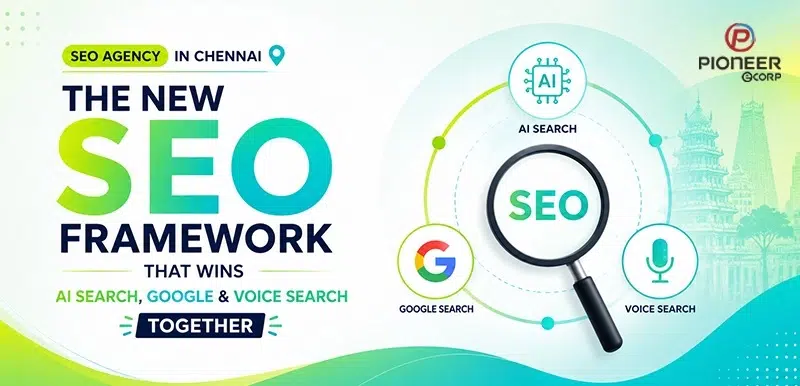
SEO Agency in Chennai: The New SEO Framework That Wins AI Search, Google & Voice Search Together
Search has quietly split into three battlegrounds. There’s still Google’s blue links. There’s the AI Overview box sitting above them. And there’s the voice assistant on someone’s phone reading out one single answer instead of ten.
If your SEO agency in Chennai is only fighting the first battle, you’re already losing two others.
This guide breaks down exactly how Pioneer eCorp approaches SEO in 2026 — not as a ranking exercise, but as a visibility framework built for Google, AI search engines like ChatGPT and Gemini, and voice search, all at once.
What's Covered
- Why "SEO Agency in Chennai" Searches Have Changed
- What Is the New SEO Framework?
- Pillar 1: Traditional SEO (Google Rankings)
- Pillar 2: AEO — Answer Engine Optimization
- Pillar 3: GEO — Generative Engine Optimization
- Pillar 4: Voice Search Optimization
- Why Chennai Businesses Need This Now
- How Pioneer eCorp Builds EEAT Into Every Campaign
- Choosing the Right SEO Agency in Chennai
- People Also Ask
Why "SEO Agency in Chennai" Searches Have Changed
A few years ago, ranking an “SEO agency in Chennai” page meant one thing: get into the top 10 blue links and wait for clicks.
That world doesn’t exist in the same way anymore.
Search behavior data through 2026 shows a majority of Google searches now end without a single click — the searcher gets their answer directly on the results page and moves on. Google’s AI Overviews now show up on a large and growing share of queries, pulling the answer straight out of a webpage and displaying it before any link is shown.
At the same time, ChatGPT, Gemini, Perplexity, and Claude are becoming genuine research tools. People ask them “which is the best SEO agency in Chennai for a small business” the same way they used to type it into Google.
So the real question local businesses in Chennai should be asking isn’t “how do I rank on Google” anymore. It’s: how do I get recommended, cited, and shown — across every surface where someone searches?
That’s the gap Pioneer eCorp built its current SEO framework to close.
What Is the New SEO Framework?
Instead of treating SEO as one discipline, we split it into four pillars that work together:
- Traditional SEO — technical health, on-page optimization, backlinks, local SEO
- AEO (Answer Engine Optimization) — structuring content so AI Overviews and featured snippets can lift it directly as an answer
- GEO (Generative Engine Optimization) — building the brand authority and content structure that gets your business mentioned or cited inside AI chat answers
- Voice Search Optimization — writing and structuring content the way people actually speak, not the way they type
These four pillars stop delivering real results the moment you treat them separately. Take a page sitting at position one on Google — if it isn’t built in a way AI systems can pull from, it’ll still fade out of AI Overviews. A brand with strong AI citations but weak technical SEO will still struggle with organic traffic. You need all four working together.
How a SEO Agency in Chennai Builds Pillar 1: Traditional SEO (Google Rankings)
This is still the foundation. Nothing above it works if this layer is broken.
On-Page & Technical SEO
- Fast-loading, mobile-first website architecture
- Well-organized URL paths and a logical heading order running from H1 down through H2 and H3
- Optimized meta titles and descriptions built around real search intent
- Internal links laid out in a way that helps both visitors and search bots move through the site with a clear sense of direction
- Core Web Vitals and page speed, since slow sites lose both rankings and AI citations
Keyword Strategy That Actually Matches Intent
Our team plots out the core phrase — “SEO agency in Chennai” — alongside close variants a searcher might actually type, such as “digital marketing company in Chennai” or “best SEO services in Chennai,” plus related terms like “local SEO Chennai,” “SEO consultant Chennai,” and “affordable SEO packages Chennai.” Each one gets mapped to the intent behind it, not just how often it’s searched.
Local SEO for Chennai Businesses
For a Chennai-based SEO agency, local signals carry serious weight:
- Google Business Profile optimization with accurate categories, service areas, and review management
- Localized landing pages for neighborhoods and business districts across Chennai
- Local citations and NAP (Name, Address, Phone) consistency across directories
- Location-specific schema markup
Pillar 2: AEO — Answer Engine Optimization
AEO is about making your content the thing that gets pulled directly into Google’s AI Overview or a featured snippet, instead of just linked below it.
How AEO Works in Practice
- Answer-first formatting — a clear, direct answer within the first 40–60 words of a section, followed by supporting detail
- Structured content — bullet points, numbered steps, comparison tables, and FAQ blocks that AI systems can parse cleanly
- Schema markup — FAQ schema, HowTo schema, and Organization schema that explicitly tell search engines what your content means
- Clarity over cleverness — AI extraction favors plain, well-organized language over dense marketing copy
A page written for AEO doesn’t sacrifice depth. It just puts the answer up front, then earns the click for the “why” and “how” behind it.
Pillar 3: GEO — Generative Engine Optimization
GEO is the newest and, honestly, the most misunderstood pillar. It isn’t about ranking on a results page at all — it’s about being the brand an AI system chooses to mention when someone asks it a question conversationally.
What Actually Moves the Needle for GEO
- Earned coverage and backlinks from reputable sites — generative models draw on how a brand is talked about across the internet, not only on the pages it owns
- Consistent brand entity signals — the same business description, services, and positioning across your site, Google Business Profile, LinkedIn, and directories
- Original data and expert commentary — content that says something a competitor's page doesn't, which is exactly what generative engines look to cite
- Structured, well-organized long-form content that a language model can summarize accurately without misrepresenting your business
Practically speaking, a Chennai SEO agency working toward GEO visibility needs a presence well beyond its own domain — think roundup articles within the industry, listings on local business directories, mentions in the press, and write-ups on other credible sites. Anywhere an AI tool might form its picture of “who’s a trustworthy SEO agency in Chennai,” your brand should show up.
Pillar 4: Voice Search Optimization
Voice search still gets underestimated, but it’s grown steadily as smart assistants and in-app voice search became everyday habits.
Key Differences for Voice SEO
- Conversational, long-tail phrasing — "who is the best SEO agency near me in Chennai" instead of "SEO agency Chennai"
- Question-based headers — structuring H2s and H3s as actual questions people would ask out loud
- Featured snippet targeting — voice assistants very often read out the featured snippet as the spoken answer
- Local intent — a large share of voice searches carry local intent ("near me," "in Chennai," "close by")
Writing for voice search and writing for AEO overlap heavily, which is exactly why treating these as one integrated framework — rather than four separate projects — saves time and compounds results faster.
SIGNATURE FLOW
From Google Click to AI Citation
Technical SEO → Answer-First Content (AEO) → Earned Mentions (GEO) → Voice-Ready Structure
Each stage builds the trust signals the next stage depends on.
Why Chennai Businesses Need This Now
Chennai’s digital economy has grown fast — IT services, manufacturing, real estate, healthcare, and D2C e-commerce brands are all fighting for the same searchers, and increasingly, the same AI-generated answers.
A few realities worth sitting with:
- AI referral traffic is still a small slice of total web traffic today, but it's growing quickly, and the businesses building AI visibility now are securing a head start before the space gets crowded
- Zero-click search is no longer the exception — it's close to becoming the default way most searches resolve
- Search engines increasingly filter for trust signals before extracting or citing content, which is exactly what E-E-A-T was built to measure
Waiting for “AI search to become mainstream” isn’t really a strategy anymore — for a large and fast-growing share of searches, it already is.
SEO Services That Depend on AI Visibility
SEO
Technical health, on-page optimization and local SEO built on Google's ranking fundamentals.
AEO
Answer-first content structuring that gets pulled directly into AI Overviews and featured snippets.
GEO
Brand authority and earned mentions that get you cited inside ChatGPT, Gemini and Perplexity answers.
Voice Search
Conversational, question-based content structured for how people actually speak their searches.
“EEAT and GEO aren’t separate goals — they’re the same goal, viewed from two different angles.”
How Pioneer eCorp Builds EEAT Into Every Campaign
Google’s E-E-A-T framework — Experience, Expertise, Authoritativeness, Trustworthiness — isn’t a checkbox. It’s increasingly the filter AI systems use to decide whose content is safe to cite.
Here’s how that shows up in our process:
- Experience — content written by people who have actually run the campaigns, not generic templates. Real case studies, real screenshots, real before-and-after data from Chennai-based client accounts
- Expertise — author bios, credentials, and clear subject-matter ownership on every published piece
- Authoritativeness — consistent backlinks and mentions from credible, relevant sources, not link farms
- Trustworthiness — transparent methodology, accurate data (pulled from tools like Google Search Console, Ahrefs, and PageSpeed Insights), and no inflated promises
Choosing the Right SEO Agency in Chennai: A Checklist
If you’re evaluating agencies, here’s what actually separates a modern SEO partner from one still running a 2018 playbook:
- Do they talk about AI Overviews, AEO, and GEO — or only rankings and backlinks?
- Can they show real Chennai client results, not generic case studies?
- Do they audit technical SEO and content structure for AI extraction?
- Do they track AI citation visibility, not just Google Search Console rankings?
- Is their own content genuinely well-structured, fast, and answer-first — practicing what they sell?
People Also Ask
An SEO agency in Chennai manages technical website health, on-page optimization, content strategy, local search visibility, and link building to help a business rank higher on Google and, increasingly, get surfaced inside AI-generated search answers.
Costs vary widely based on scope, but most Chennai-based SEO agencies offer tiered monthly packages, ranging from basic local SEO retainers for small businesses to comprehensive enterprise packages covering technical SEO, content, AEO, and GEO. Pricing typically depends on competition level, website size, and how many locations or services need coverage.
SEO focuses on ranking web pages in traditional search results. AEO (Answer Engine Optimization) focuses on getting content extracted directly into AI Overviews and featured snippets. GEO (Generative Engine Optimization) focuses on getting a brand mentioned or recommended inside conversational AI answers from tools like ChatGPT or Gemini. They overlap but require different tactics.
Most SEO campaigns start showing measurable movement — improved rankings, more organic traffic, better local visibility — within 3 to 6 months, with stronger compounding results typically appearing after 6 to 12 months of consistent work. Highly competitive keywords take longer than local, long-tail terms.
Yes, especially for local Chennai businesses. Voice searches lean heavily toward local, conversational, “near me” style queries, and voice assistants typically read out only one answer — usually the featured snippet — making it a high-value, low-competition opportunity if optimized correctly.
You can manually test this by asking ChatGPT, Gemini, Perplexity, or Claude questions a potential customer might ask, such as “best SEO agency in Chennai,” and checking whether your business is mentioned. Some SEO tools have also started building AI citation tracking specifically for this purpose.
Final Thoughts
Chennai’s SEO landscape isn’t just getting more competitive — it’s getting more complex. Ranking on Google is still essential, but it’s no longer the finish line.
The businesses that win over the next few years will be the ones treating traditional SEO, AEO, GEO, and voice search as one connected system, built on genuine expertise and real trust signals — not the ones still optimizing for a search landscape that’s already changing underneath them.
That’s the framework Pioneer eCorp builds every Chennai SEO campaign around.
Ready to See Where You Stand in AI Search?
Most Chennai businesses are already losing visibility in AI Overviews without knowing it. A short audit shows exactly where you stand — and what it would take to fix it.
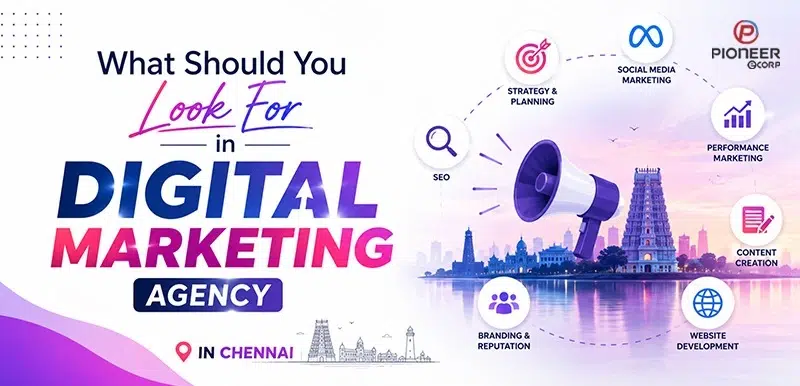
What to Look for in a Digital Marketing Agency in Chennai
Chennai’s business scene is growing fast, and so is the number of agencies promising to grow it with you. If you’ve started searching for a digital marketing agency in Chennai, you’ve probably run into the same problem everyone else does — too many options, and almost no easy way to tell them apart. This guide breaks down exactly what to check before you sign anything, so you end up with a partner who moves your numbers, not just your inbox.
Why the Right Agency Matters More Than Ever
Chennai is home to everything from IT parks and auto manufacturing hubs to retail chains and B2B exporters. That mix means competition online looks different depending on your industry, but the fundamentals stay the same: you need visibility on search, credibility on social platforms, and a partner who can prove both are working. A generalist agency that treats every client the same way usually can’t deliver that. A specialist SEO agency Chennai businesses actually trust, paired with solid social media marketing execution, is a very different thing — and worth knowing how to spot.
The Core Checklist: What to Look For
1. A Verifiable Track Record
Ask for real client names, live rankings, or before-and-after traffic data — not just logos on a slide. Any agency calling itself an SEO agency Chennai clients can rely on should be able to show ranking movement, not just “we do SEO” as a bullet point.
2. Genuine Social Media Marketing Skill
Posting daily isn’t a strategy. Look for agencies that can explain how their social media marketing work ties back to leads, bookings, or sales — and ask to see engagement or conversion numbers from past campaigns, not just follower counts.
3. Transparent, Plain-Language Reporting
You should never need a marketing degree to understand your own monthly report. Good agencies explain what changed, why it changed, and what’s next — in language you can repeat to your own team.
4. Experience in Your Industry (or Something Close to It)
A team that has only worked with restaurants will approach a B2B manufacturing client very differently than one who understands long sales cycles and technical buyers. Industry familiarity shortens the learning curve significantly.
5. Clear Ownership and a Single Point of Contact
Somebody on the agency side should own your account end to end. If every question gets passed between three different people with three different answers, that’s a structural problem, not a one-off.
6. Pricing That Matches the Deliverables
The cheapest quote is rarely the best deal. Ask exactly what’s included — number of content pieces, ad spend management, reporting frequency — before comparing prices at all.
A Step-by-Step Framework to Evaluate an Agency
- Shortlist 3–4 agencies based on referrals, reviews, or search visibility of their own site.
- Request case studies relevant to your industry or business size, not generic examples.
- Book a discovery call and ask how they'd approach your specific business in the first 30 days.
- Check their own SEO and social presence — an agency that can't rank or grow itself is a warning sign.
- Ask for a sample report so you know what you're paying to receive every month.
- Clarify contract terms, including notice periods and what happens if targets aren't met.
In-House Team vs Freelancer vs Digital Marketing Agency
| Factor | In-House Team | Freelancer | Digital Marketing Agency |
|---|---|---|---|
| Upfront Cost | High (salaries, tools) | Low to moderate | Moderate, scalable |
| Skillset Range | Limited to hires made | Usually narrow, one niche | Broad — SEO, ads, content, design |
| Scalability | Slow, needs new hires | Limited by one person’s time | Flexible, scales with retainer |
| Accountability | Internal, informal | Depends on individual | Contract-based, reportable |
| Tool Access | Company must buy separately | Often limited | Usually included |
| Turnaround on Multi-Channel Work | Slower | Slow for parallel tasks | Faster, dedicated roles |
The 90-Day Trial Framework (Before You Sign Long-Term)
Most blogs stop at “ask for case studies.” A more useful approach is structuring your first three months as a defined trial, even within a standard retainer. Set specific, measurable checkpoints at day 30, 60, and 90 — covering things like keyword ranking movement, content published, or campaign reach. Agree on this timeline in writing before work begins, along with a simple exit clause if targets are clearly missed without explanation. This protects you from a full-year lock-in with an agency that looks good on paper but underperforms in practice, and it gives a genuinely good agency an easy way to prove its value early.
Sector-Fit Check: Does the Agency Actually Understand Your Industry?
This is the part most comparison blogs skip entirely. It’s not enough for an agency to have “10 years of experience” — that experience needs to match how your buyers actually behave. A team that has only handled fast-moving retail or D2C brands may struggle with a B2B manufacturing client where the sales cycle runs months, not days. Before signing, ask specifically: “Have you worked with a business in our sector, and what did that campaign actually look like?” If the only answer is a generic case study reused across every pitch, treat that as a gap, not a green flag. The right sector-fit shows up in smaller details — how they talk about your customer, what channels they prioritize, and whether their content ideas sound like they understand your industry or just your industry’s keywords.
Common Red Flags to Watch For
- Guarantees of “#1 ranking” with no context on keyword difficulty or timeline
- Vague reporting with no explanation of what the numbers mean
- Reluctance to share real client references
- One-size-fits-all packages regardless of business size or goals
- No clear point of contact, or constant staff turnover on your account
Frequently Asked Questions
How much does a digital marketing agency in Chennai typically charge?
Pricing varies depending on the services you need, but most agencies offer flexible monthly retainers instead of one-time packages. Before comparing prices, review exactly what’s included in each plan, such as SEO, PPC, content creation, social media management, reporting, and support.
How long does SEO take to show results with a Chennai-based agency?
SEO is a long-term strategy. Most businesses begin seeing measurable improvements within 3 to 6 months, while stronger rankings, traffic growth, and lead generation typically become more noticeable after 6 to 12 months of consistent optimization.
Should social media marketing and SEO be handled by the same agency?
In many cases, yes. Managing SEO and social media together helps maintain consistent branding, supports content marketing efforts, and improves overall campaign performance. If separate vendors are involved, regular coordination is essential.
What’s a reasonable contract length to start with?
A 3-month trial period is a practical starting point. It gives enough time to evaluate communication, reporting quality, campaign execution, and initial performance before considering a longer-term agreement.
How do I know if an agency’s results are genuine?
Request direct access to Google Analytics 4, Google Search Console, and advertising dashboards instead of relying only on monthly reports. Transparent agencies are comfortable sharing real-time performance data and explaining the results.
Final Thoughts
Choosing a digital marketing agency in Chennai comes down to verifiable proof, industry fit, and clear communication — not the flashiest pitch deck. Use the checklist and the 90-day framework above to separate agencies that talk about results from ones that can actually show them.
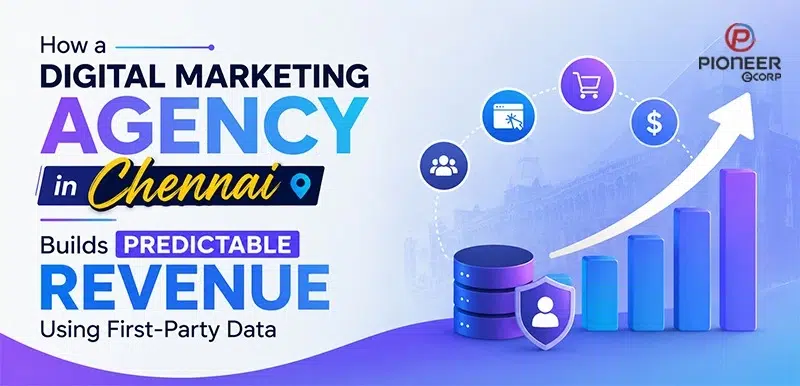
How First-Party Data Builds Predictable Revenue
If you’ve asked ten different marketers in Chennai what “first-party data” means, you’ve probably gotten ten different answers — half of them wrong. That confusion is expensive, and it shows up directly in ad spend that doesn’t convert.
A digital marketing agency in Chennai that actually understands first-party data does something different. Instead of guessing who might buy, it builds systems that tell you, with real numbers, who already wants to.
What's Covered
Why Chennai Businesses Need a Data-Driven Digital Marketing Agency
Chennai’s business landscape has changed fast over the last five years. Manufacturing companies in Ambattur and Guindy now compete for the same online attention as D2C brands in Nungambakkam — everyone fighting for the same limited pool of clicks.
At the same time, the tools that used to make targeting “easy” are disappearing. Third-party cookies are being phased out, iOS privacy changes have already weakened ad tracking, and platform ad costs keep climbing with no guarantee of better results.
In this environment, a business that owns its customer data has a real advantage over one that only rents its audience from Meta or Google. This is exactly why more Chennai businesses now work with a digital marketing agency in Chennai that treats first-party data as the foundation of strategy, not an afterthought.
What Is First-Party Data, Really?
First-party data is any information a business collects directly from its own audience, with their knowledge and consent. The key word is direct — it doesn’t come from a third-party broker or an ad platform’s black box.
- Website behavior — pages visited, time on site, products viewed
- Email sign-ups and newsletter engagement
- Purchase history and order values
- Form submissions and inquiry details
- App usage and login activity
- Customer service conversations and support tickets
First-Party vs. Third-Party vs. Zero-Party Data
These three terms get mixed up constantly. Here’s the short version, side by side.
First-Party Data
Collected directly by you — website, app, CRM, or point-of-sale. Owned, accurate, and yours to keep.
Third-Party Data
Purchased or licensed from external brokers. Losing value fast due to cookie deprecation and privacy law.
Zero-Party Data
Proactively shared by customers — quiz answers, survey responses, stated preferences.
A strong digital marketing agency in Chennai builds strategy around the first two categories — owned, direct data — with zero-party data used to fill in gaps that behavioral tracking alone can’t answer.
How a Digital Marketing Agency in Chennai Builds Predictable Revenue Using First-Party Data
Here’s where the real work happens — the actual process an agency follows, step by step.
01 · Data Collection Audit
Every place your business already touches a customer gets mapped — website forms, checkout flow, WhatsApp Business, CRM, even offline billing software.
02 · Centralizing the Data
Scattered data is useless data. Leads, email lists, and sales records get consolidated into a single CRM so every interaction ties back to one customer profile.
03 · Segmentation by Real Behavior
Someone who visited your pricing page three times is a different audience than someone who read one blog post.
04 · Lookalike & Retargeting Audiences
High-intent first-party audiences get uploaded to Google Ads and Meta to build far more accurate lookalike audiences.
05 · Predictive Revenue Modeling
Patterns emerge from historical data — which channels bring the highest lifetime value, which content precedes a sale.
06 · Continuous Testing & Refinement
Every campaign generates more data, which sharpens the next campaign’s targeting — this compounding loop is what makes revenue predictable.
Digital Marketing Services That Depend on Strong First-Party Data
SEO
Understanding what real visitors search for and click on prioritizes content that ranks and converts.
Email Marketing
Behavioral segmentation is what separates a 2% open rate from a 25% open rate.
Conversion Optimization
Real behavioral data reveals exactly where prospects drop off — and why.
PPC Advertising
Custom audiences from real customer lists consistently outperform broad interest targeting.
Content Marketing
Knowing what existing customers engage with tells you what to write next.
Social Media Marketing
Retargeting warm, first-party audiences typically costs less than targeting cold ones.
A Realistic Example: How This Plays Out for a Local Business
Consider a mid-sized manufacturing business in Chennai selling industrial equipment. For years, it ran generic Google Ads targeting broad keywords, tracking nothing beyond click count.
A data-first approach instead connects website form submissions, WhatsApp inquiries, and past purchase records into one system. Patterns become visible within a few months: inquiries mentioning a specific product category close at a much higher rate.
That insight reshapes the ad strategy — budget shifts toward the highest-converting category, with a retargeting sequence built for past buyers approaching their repurchase window.
How to Choose the Right Digital Marketing Agency in Chennai
- Data infrastructure clarity — they can explain how they'll collect, store, and use your data.
- Transparent reporting — real numbers tied to revenue, not just reach or impressions.
- Privacy compliance approach aligned with India's data protection expectations.
- Local Chennai experience across different business categories.
- A real testing process — predictable revenue comes from continuous refinement.
People Also Ask
Pricing varies by scope, but most Chennai agencies structure fees as monthly retainers based on the number of services and the ad budget being managed.
Yes, as long as it’s collected with proper consent and disclosed to users, in line with India’s Digital Personal Data Protection Act.
Basic infrastructure can be done within 4 to 6 weeks. Meaningful predictive insight usually needs 3 to 6 months of consistent data collection.
Small businesses often benefit the most — first-party data lets them compete on targeting precision rather than ad budget size.
An agency brings strategy, data infrastructure, design, and execution together under one roof — useful for work spanning multiple systems.
First-party audiences already know your brand, so they convert at higher rates than cold targeting — typically lowering cost per acquisition over time.
Ready to see how much first-party data your business already has?
Most Chennai businesses are sitting on more useful customer data than they realize. A short audit shows exactly what it could be doing for your revenue.
How to Get More Customers Online with Digital Marketing: 10 Proven Strategies
Most business owners don’t struggle to get a website — they struggle to get customers from it. This guide covers 10 proven digital marketing strategies that turn visitors into real, paying customers, and it’s exactly the kind of playbook a digital marketing agency, especially a trusted digital marketing agency in Chennai, uses every day. Getting more customers online is not about doing everything at once. It is about doing the right things, in the right order, consistently.
These 10 proven digital marketing strategies actually move the needle, plus there are two areas most blogs skip entirely.
1. Start With a Website That Converts, Not Just Looks Good
A pretty website that doesn’t convert is a expensive brochure. Before spending on ads or SEO, fix the basics:
- Clear headline explaining what you do and for whom
- A visible call-to-action (call, WhatsApp, or form) above the fold
- Fast loading speed on mobile
- Trust signals — reviews, certifications, client logos
Example: A footwear brand that added a sticky “Order on WhatsApp” button saw more enquiries within weeks, simply because the friction to contact them dropped.
2. Rank on Google With Local SEO
If customers search “near me” or “in Chennai” and you don’t show up, you’re invisible. Local SEO includes:
- Optimising your Google Business Profile with correct category, photos, and hours
- Getting genuine customer reviews
- Using city and locality names naturally in your service pages
- Building local citations on directories
This is exactly the kind of work a digital marketing agency handles best, and it’s also why so many businesses specifically look for a digital marketing agency in Chennai — local search intent converts faster than almost any other channel.
3. Build Topic-Based Content, Not Just Random Blogs
Google rewards websites that show depth on a subject, not scattered one-off posts. Instead of writing 20 unrelated blogs, build a content cluster:
- One core “pillar” page (e.g., “Complete Guide to Industrial Equipment Maintenance”)
- Multiple supporting blogs linking back to it
- Internal links connecting related pages
This structure signals topical authority, which search engines increasingly reward over keyword-stuffed pages.
4. Use Paid Ads to Get Immediate Traction
SEO takes time. Paid ads (Google Search, Meta, or LinkedIn) fill the gap while your organic presence grows.
- Google Search Ads target people actively searching for your product
- Meta Ads work well for visual products and retargeting
- LinkedIn Ads suit B2B and manufacturing businesses
Set a clear budget, track cost-per-lead, and pause what isn’t working within the first two weeks.
5. Retarget Visitors Who Didn't Convert
Most visitors leave without buying the first time. Retargeting ads bring them back:
- Show a special offer to cart abandoners
- Display testimonials to people who viewed your pricing page
- Remind past visitors with a limited-time discount
Retargeting typically costs less per click and converts significantly higher than cold traffic.
6. Turn Email Into a Revenue Channel
Email is often ignored, yet it remains one of the highest ROI channels available.
- Send a welcome series to new subscribers
- Share useful tips, not just promotions
- Segment by interest so messages stay relevant
A B2B manufacturer, for instance, can nurture leads over months with monthly updates until they’re ready to buy — something a single ad can never do.
7. Leverage Social Proof Everywhere
Customers trust other customers more than they trust brands. Collect and display:
- Star ratings and written reviews
- Case studies with real numbers
- Short video testimonials
Place this proof near your call-to-action buttons, not buried on a separate page.
8. Optimise for Voice and Conversational Search
More customers now search using full questions, especially on mobile. Instead of just targeting “footwear Chennai,” also target phrases like “where can I buy comfortable formal shoes in Chennai.” Write content that answers questions directly, in plain language, near the top of the page.
9. Track the Right Metrics, Not Vanity Numbers
Followers and impressions feel good but rarely pay bills. Focus on:
- Cost per lead
- Lead-to-customer conversion rate
- Customer lifetime value
Reviewing these monthly tells you which strategies to scale and which to cut.
10. Combine Channels Instead of Relying on One
The businesses that grow fastest online rarely depend on a single channel. SEO brings long-term traffic, ads bring immediate leads, email nurtures them, and social proof closes the sale. This is why most businesses eventually partner with a digital marketing agency — to treat digital marketing as one connected system, not separate departments.
Why "More Traffic" Isn't the Same as "More Customers"
Most articles stop at traffic tips. But traffic without intent-matching is wasted spend. A page ranking for 10,000 searches a month means nothing if those searchers aren’t ready to buy. Before chasing volume, map your content and ads to where the customer actually is:
- Awareness stage: Educational blogs, social content
- Consideration stage: Comparison pages, case studies
- Decision stage: Pricing pages, demo requests, WhatsApp/call buttons
Businesses that map content this way convert a far higher percentage of their traffic, even with lower total visitor numbers.
The Trust Gap Between Ad Click and First Purchase
The Trust Gap Between Ad Click and First Purchase
There is a gap between someone clicking your ad and actually trusting you enough to pay. Most brands ignore this gap entirely. Closing it involves:
- Showing a real business address and GST details on your site
- Adding a founder or team photo, not stock images
- Responding to enquiries within minutes, not days
- Offering a low-risk first step, like a free consultation or sample
This “trust gap” is often the real reason ad campaigns fail to convert, even when targeting and creatives are solid. Fixing it usually costs nothing but attention.
Frequently Asked Questions
Getting more customers online isn’t about chasing every new trend. It’s about building a system where SEO, ads, content, and trust all work together. Start with one or two strategies above, measure the results, and expand from there.
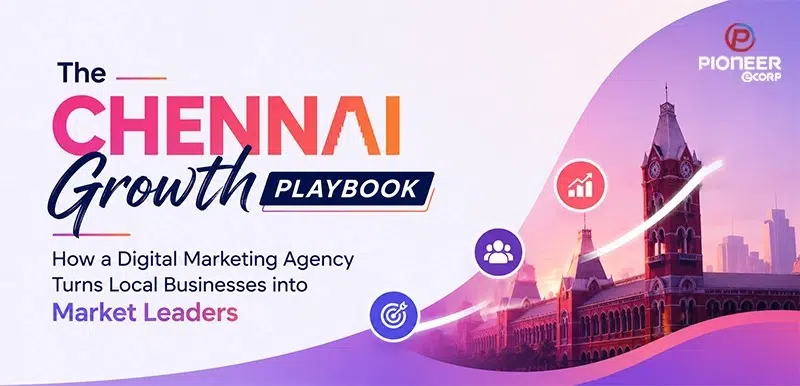
The Chennai Growth Playbook: A Local Business Growth Framework
A textile shop in T Nagar and a D2C skincare brand shipping out of Guindy shouldn’t really be competitors. But on Google, they often are — both fighting for the same buyer’s attention on the same results page.
That’s pushed more local businesses toward hiring a digital marketing agency in Chennai rather than piecing together ads and SEO on their own. The competition didn’t move online recently — it’s been there for years. Plenty of businesses are only now catching up.
This guide walks through what a real digital marketing agency does day to day, what separates a solid one from a forgettable one, and how Chennai businesses can turn that partnership into actual revenue instead of just “having a presence” online.
Why Local Businesses in Chennai Can't Skip Digital Marketing Anymore
A decade back, a decent shopfront and steady word-of-mouth carried most businesses. That formula has quietly stopped working, even in long-established markets like Adyar, Nungambakkam, or Velachery.
Buyers now check Google, skim reviews, and scroll a business’s Instagram before they ever pick up the phone. Miss that moment online, and a competitor two search results down gets the call instead.
This shift is exactly why SEO services in Chennai, paid campaigns, and active social profiles stopped being “nice to have.” Visibility at the exact moment someone’s ready to buy has become the whole game.
The OMR Effect
The IT corridor along OMR has brought in a younger customer base that researches everything before spending a rupee — comparison shopping, reading reviews, checking a brand’s socials.
A digital marketing agency in Chennai that understands this crowd can put a local business directly in their path, ahead of a bigger competitor with a bigger ad budget but zero local context.
Neighborhood Shops Now Compete With the Entire Country
A small boutique in Alwarpet isn’t just up against the store next door anymore. Local businesses now compete with Meesho vendors, Instagram-based sellers, and large e-commerce platforms that deliver products from across the country.
Getting noticed today takes a deliberate plan — not a shop Facebook page that hasn’t been touched since last Pongal.
Inside a Full-Service Digital Marketing Agency: What's Actually on the Table
“Digital marketing” gets used as a catch-all term, which makes it confusing. A proper agency usually runs several connected disciplines at once, not just one isolated service.
Search Engine Optimization
SEO is the base layer everything else sits on. It covers fixing technical issues on a site, tightening on-page content, and earning the kind of backlinks that actually move rankings.
A capable SEO agency in Chennai also handles the local layer — Google Business Profile setup, locality-specific landing pages, and directory citations — so a business shows up when someone searches from a specific area rather than the city in general.
Paid Search and Social Ads
Google Ads and Meta campaigns bring in traffic immediately, while SEO is still building momentum underneath. A sharp PPC agency in Chennai knows how to narrow targeting to specific localities and cut spend that isn’t converting.
Social Content and Community Management
Instagram and Facebook have turned into discovery channels, not just brand pages. Social media marketing in Chennai now leans heavily on reels, small local influencer tie-ups, and retargeting ads — a monthly post calendar alone won’t move the needle.
Web Design and Development
Every campaign eventually points somewhere. If that destination is a slow, cluttered, or non-mobile site, the click was wasted money.
Agencies that pair SEO strategy with actual WordPress development tend to fix these gaps faster, since the technical build and the marketing plan aren’t split across two unconnected teams.
Content Built for AI Search, Not Just Google
Search behavior is shifting again. People increasingly ask ChatGPT or Google’s AI Overviews a direct question instead of clicking through a list of links.
Agencies paying attention are already writing for Generative Engine Optimization (GEO) and Answer Engine Optimization (AEO) — structuring content so AI tools can pull it up and credit the business as a real source, not just index it.
Why a Chennai-Rooted Team Outperforms an Outsider Agency
Plenty of agencies claim to “do SEO” without understanding Chennai’s market at all. Many business owners don’t realize how much that difference affects their growth.
Search Behavior Here Isn’t Purely English
Tamil and Tanglish queries don’t behave like standard English search terms. A digital marketing company in Chennai that gets this can shape ad copy and content around how people here actually type and speak, not a textbook version of it.
Getting Localities Right Actually Matters
Local SEO leans on precise, correct details — the right locality spelling, nearby landmarks, accurate service-area boundaries for places like Porur, Perungudi, or Tambaram.
Agencies without ground-level context get these small details wrong constantly, and it drags rankings down without anyone noticing why.
Fewer Delays, More Context
A Chennai-based team means no time-zone lag, no explaining why footfall dips during Margazhi season, and quicker turnarounds when a campaign needs an on-the-fly adjustment.
Picking a Digital Marketing Agency in Chennai Without Getting Burned
Agencies aren’t interchangeable, and a bad pick can burn through months of budget with nothing measurable to show afterward. Start by reviewing these essential factors before choosing a service provider.
Ask to See Actual Numbers, Not Just a Pitch Deck
A credible agency can point to real ranking shifts, traffic growth, or ad performance — even if client names stay private for confidentiality.
Understand How They Report Progress
A vague “things are improving” update every month isn’t reporting. Look for agencies that show hard numbers: keyword position changes, organic traffic trends, conversions, and how efficiently ad spend is being used.
Watch for Shortcuts Dressed Up as Strategy
Be cautious of anyone guaranteeing a top ranking within days, or leaning on tactics like link farms and repetitive keyword insertion. These trip Google’s spam detection and the fallout can take months to reverse.
A dependable SEO company in Chennai earns rankings through genuine E-E-A-T signals — demonstrated experience, subject knowledge, credible content, and trust — not manipulation.
Make Sure They’ve Actually Worked in Your Industry
A fashion e-commerce brand, a real estate developer, and a clinic all need fundamentally different approaches. An agency with real cross-industry experience will ask sharper, more specific questions before pitching anything.
The Pioneer eCorp Growth Playbook
Pioneer eCorp is a Chennai-based digital marketing agency built on one principle — marketing should produce numbers you can point to, not just activity.
Every Engagement Starts With an Audit
Before any strategy gets built, the process starts with a technical audit: site health, keyword gaps, competitor positioning, and how visible the business already is in local search.
Local SEO Mapped to Actual Neighborhoods
Instead of targeting “Chennai” as one broad blob, campaigns get built around how people search by locality and intent — from Anna Nagar to OMR to Velachery — since those searches behave differently from each other.
Content Built Around Real Expertise
Every piece of content is meant to show genuine knowledge, not just repeat a keyword phrase enough times to rank. That means original insight, accurate detail, and structure that earns trust from readers and search engines alike.
SEO, Ads, and Web Development Under One Roof
Because strategy, content, and site development aren’t split across separate vendors, SEO recommendations get implemented directly rather than sitting in a backlog waiting on someone else’s team.
Experience Across Different Kinds of Businesses
The work has spanned fashion and footwear retail, real estate, hospitality, and service businesses — each with a different customer journey and a different idea of what counts as a “win.”
Where Chennai Businesses Usually Lose Marketing Budget
A lot of wasted spend traces back to the same handful of mistakes, repeated across different industries.
Treating SEO Like a Task That Gets “Finished”
SEO doesn’t have a finish line. Google’s algorithm keeps shifting, and competitors keep publishing. Rankings need continuous upkeep, not a one-time setup and a checked box.
Sending Paid Traffic to the Wrong Page
Pointing ad clicks at a generic homepage instead of a focused landing page tanks conversion rates almost every time. The click still costs money — a weak destination page just wastes it.
Leaving Google Business Profile Untouched
For any business with a physical address or defined service area, a neglected or outdated Google Business Profile is one of the most common — and most fixable — local SEO gaps out there.
Optimizing for Numbers That Don’t Translate to Sales
Follower counts and reach look good on a slide, but they don’t move revenue on their own. Calls, form fills, and actual purchases are what a strategy should be judged against.
People Also Ask (PAA)
Final Word: Consistency Beats a Lucky Post Every Time
Businesses that keep growing online aren’t the ones that landed one viral reel. They’re the ones running SEO, content, and ads together as a single system, month after month, without gaps.
That’s really what a genuine digital marketing agency in Chennai offers — not just campaigns running in isolation, but a growth system that keeps compounding on itself.
If the goal is to stop guessing and start growing with a plan built specifically around how Chennai’s market actually searches and buys, that’s the exact gap a local, data-driven partner like Pioneer eCorp is meant to close.