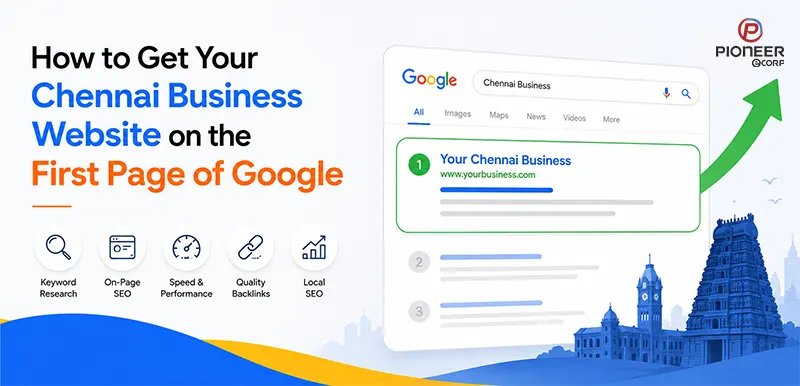
How to Get Your Chennai Business Website on the First Page of Google
If you’re a business owner in Chennai wondering how to rank on Google, you’re not alone. Every day, thousands of potential customers search for products and services just like yours — and they rarely go past the first page. In fact, if your website isn’t showing up in those top results, your competitors are quietly winning the business that could have been yours. That’s the reality of digital marketing in 2026, and it’s exactly why SEO has become one of the most important investments any Chennai business can make.
The good news? You don’t need a massive budget or a tech background to make it happen. What you do need is the right strategy, consistency, and a clear understanding of how Google actually works. This guide walks you through exactly that.
1. Why Google's First Page Matters More Than Ever
Let’s start with a simple truth: over 90% of searchers never scroll past page one. If your Chennai business isn’t visible there, you’re essentially invisible online. Whether you run a restaurant in Anna Nagar, a clothing boutique in T. Nagar, or an IT services firm in OMR, your customers are searching for you right now — the question is whether they can find you.
This is where SEO steps in. Search Engine Optimisation is the practice of making your website more relevant, trustworthy, and technically sound in Google’s eyes. When done right, it doesn’t just push you up the rankings — it brings you the kind of organic traffic that converts into real leads and loyal customers.
2. Start With Keyword Research — Know What Your Customers Are Searching
Before you write a single word for your website, you need to understand how people in Chennai are actually searching for your services. This is the foundation of any successful digital marketing strategy.
Think about it from your customer’s perspective. Someone looking for a CA firm in Chennai might type ‘best chartered accountant in Chennai’ or ‘GST filing services Nungambakkam.’ These are your keywords — the actual phrases people use when they have a need and are ready to act.
Tools like Google Keyword Planner, Ubersuggest, or even Google’s autocomplete feature can show you what’s trending in your space. Focus on a mix of:
- Short keywords like ‘digital marketing Chennai’ — high volume but competitive
- Long-tail keywords like ‘affordable web design for small business in Chennai’ — lower volume but far easier to rank for
- Local intent keywords that include neighbourhoods or landmarks
Once you have a list, map those keywords to specific pages on your site. Your homepage might target your primary service, while blog posts and landing pages target more specific queries. This structured approach is what separates businesses that rank on Google from those that don’t.
3. Optimise Your Website — On-Page SEO That Actually Works
Getting your website to rank isn’t just about adding keywords. It’s about sending the right signals to Google — through your content, structure, and technical setup. Here’s what matters most for Chennai businesses:
- Every page needs a unique, keyword-rich title tag (under 60 characters) and a compelling meta description. Think of these as your ad copy in Google’s search results.Title Tags & Meta Descriptions:
- Break your content into clear sections using heading tags. Your main keyword should appear naturally in the H1, and supporting keywords should show up in the subheadings.Header Tags (H1, H2, H3):
- Google rewards pages that genuinely answer what users are searching for. Write for your reader first, Google second. A 700-word page that’s clear and helpful will consistently outperform a 2,000-word page stuffed with keywords.Content Quality:
- Compress your images and always add descriptive alt text. This improves page speed and helps Google understand your visual content.Image Optimisation:
- Link relevant pages within your site. This helps Google crawl your site more effectively and keeps visitors engaged longer.Internal Linking:
A well-optimised page doesn’t feel like it’s been engineered — it reads naturally, answers questions clearly, and makes the visitor want to stay. That’s exactly what SEO should feel like.
4. Local SEO — Your Biggest Advantage as a Chennai Business
Here’s where Chennai businesses have a genuine edge: local SEO. When someone searches ‘dentist near me’ or ‘AC repair in Velachery,’ Google prioritises local results — and that’s your opportunity.
Start with your Google Business Profile. If you haven’t claimed and optimised it yet, do it today. Make sure your business name, address, and phone number (NAP) are consistent across your website, Google, Justdial, and every other directory you’re listed on. Google treats consistency as a trust signal.
Next, actively collect genuine customer reviews. A Chennai restaurant with 200 positive reviews will almost always outrank a newer competitor in the local pack — even if the competitor’s website is technically superior. Reviews are social proof for both your customers and Google’s algorithm.
5. Build Authority Through Quality Content and Backlinks
Google’s algorithm rewards websites that are trusted by others. One of the clearest signals of trust is backlinks — when other reputable websites link to yours. Think of each quality backlink as a vote of confidence in your content.
For Chennai businesses, some of the most effective ways to earn backlinks include:
- Writing guest posts for Chennai-based business blogs or news portals
- Getting listed on credible local directories and chamber of commerce websites
- Partnering with complementary businesses for cross-promotions or resource mentions
- Publishing original research, case studies, or guides specific to the Chennai market
Alongside backlinks, consistent content creation is what sustains long-term Google rankings. A blog that publishes two helpful articles per month — answering real questions your customers have — compounds its traffic over time. It positions your brand as an authority, builds trust before a customer ever reaches out, and gives digital marketing a durable, organic foundation.
6. Technical SEO — The Foundation That Google Sees First
Even the best content won’t rank well if your website has technical problems. Google needs to be able to crawl, index, and render your pages without friction. For most small Chennai businesses, these are the critical technical areas to address:
- A slow website kills both rankings and conversions. Use Google PageSpeed Insights to identify issues. Compress images, enable browser caching, and consider upgrading your hosting.Page Speed:
- Over 70% of searches in India happen on mobile. Your site must look and work perfectly on a smartphone — this is non-negotiable for modern SEO.Mobile Friendliness:
- If your site still runs on HTTP, switch to HTTPS immediately. It’s a confirmed ranking factor and also builds trust with visitors.HTTPS Security:
- Submit a sitemap to Google Search Console so all your important pages get indexed. Make sure your robots.txt file isn’t accidentally blocking pages you want Google to see.Sitemap & Robots.txt:
Sorting out these technical fundamentals is often where businesses see the fastest improvement in their Google rankings. It’s not glamorous work, but it makes everything else you do far more effective.
7. Track, Measure, and Improve — SEO Is a Long Game
One of the biggest mistakes Chennai business owners make is treating SEO as a one-time task. It’s not. It’s an ongoing process — and the businesses that win consistently are the ones that monitor their performance and keep improving.
Set up Google Search Console (free) and Google Analytics (free). These two tools will tell you which keywords you’re ranking for, which pages are getting traffic, how long visitors are staying, and where they’re dropping off. Use this data to make informed decisions — update underperforming pages, double down on what’s working, and stay ahead of competitors.
Revisit your keyword strategy every quarter. Search trends shift, new competitors enter the market, and Google updates its algorithm regularly. Businesses that treat SEO as a living strategy — not a completed project — are the ones consistently holding their ground on page one.
Final Thoughts: Your First Page Journey Starts Today
Getting your Chennai business website to the first page of Google isn’t a mystery — it’s a method. A clear digital marketing strategy built on solid keyword research, optimised content, strong local SEO, and consistent effort is what separates businesses that dominate search results from those that barely get noticed.
You don’t have to do everything at once. Start with what matters most — claim your Google Business Profile, optimise your top service pages, and fix any technical issues holding you back. Build from there. How to rank on Google is a question with a real, achievable answer — and every step you take today is an investment that pays returns for years to come.
If you’re ready to take your Chennai business to the first page of Google, now is the best time to start. Your competition probably already has.
The Chennai Business Growth Formula Used by a Digital Marketing Agency in Chennai
Introduction
Pioneer Ecorp is the one of the Best Digital Marketing Agency In Chennai.
In today’s competitive online market, businesses in Chennai are no longer relying only on traditional advertising methods. Newspapers, pamphlets, banners, and word-of-mouth marketing are slowly losing their dominance.
Modern customers search online before making decisions.
Whether it is a restaurant, construction company, real estate business, hospital, educational institution, or industrial company, every customer journey starts with Google.
That is exactly why working with a professional Pioneer Ecorp can completely transform business growth.
A strategic digital marketing plan helps businesses generate quality leads, increase website traffic, improve search engine visibility, and build long-term trust online.
This article explains the proven Chennai business growth formula used by successful digital marketing experts to help brands dominate their industry online.
Why Chennai Businesses Need Digital Marketing Today
Chennai is one of India’s fastest-growing business cities.
From IT companies and manufacturing industries to real estate developers and local retail shops, competition is increasing rapidly.
Customers now compare businesses online before purchasing anything.
They check:
- Google reviews
- Website quality
- Social media presence
- Search engine rankings
- Brand reputation
- Customer testimonials
If your business is not visible online, your competitors will capture your customers.
A professional digital marketing strategy helps businesses:
- Increase online visibility
- Generate qualified leads
- Improve conversion rates
- Build customer trust
- Grow revenue consistently
- Create brand awareness
Today, digital presence is not optional.
It is a necessity for survival and long-term growth.
Understanding the Chennai Market
Every city has unique customer behavior.
The Chennai audience is highly research-oriented and trust-focused.
People in Chennai usually compare multiple businesses before making decisions. They prefer brands with:
- Strong Google presence
- Professional websites
- Good online reviews
- Active social media pages
- High search rankings
This is why local SEO and trust-building strategies play a major role in Chennai business growth.
A successful digital marketing agency in Chennai understands:
- Chennai customer psychology
- Local search behavior
- Tamil and English audience targeting
- Industry-specific competition
- Regional SEO optimization
Without local expertise, many businesses struggle to rank on Google.
What Makes a Digital Marketing Agency in Chennai Successful
Not every marketing agency delivers real results.
The best digital marketing agencies focus on business growth instead of vanity metrics.
Real success comes from:
SEO-Driven Strategy
Search engine optimization helps businesses appear on Google when customers search for products or services.
For example:
- Best builders in Chennai
- Air compressor dealers in Chennai
- Real estate company in Chennai
- SEO agency near me
- Digital marketing services Chennai
Ranking for these keywords generates consistent organic traffic.
High-Quality Content Marketing
Google rewards websites with useful and original content.
Strong content helps businesses:
- Rank faster
- Build authority
- Increase engagement
- Improve conversion rates
Content must always be:
- Human-written
- Informative
- Easy to read
- SEO optimized
- Valuable for users
Thin content no longer works in 2026.
Google prioritizes helpful and experience-based content.
Technical SEO Optimization
Technical SEO improves website performance.
This includes:
- Faster page speed
- Mobile optimization
- Proper schema markup
- XML sitemap setup
- Core Web Vitals optimization
- Secure HTTPS setup
Technical SEO directly impacts Google rankings.
Conversion-Focused Website Design
Traffic alone does not generate sales.
A business website should convert visitors into leads.
A high-converting website includes:
- Clear call-to-actions
- Fast loading speed
- Mobile responsiveness
- SEO-friendly structure
- Trust signals
- Optimized landing pages
The Chennai Business Growth Formula Explained
Successful businesses follow a structured digital marketing formula.
Here is the exact process used by leading digital marketing agencies in Chennai.
1. Local SEO Optimization
Local SEO is the backbone of Chennai business growth.
When users search for nearby services, Google displays local businesses first.
Optimizing for local SEO helps businesses rank in:
- Google Maps
- Local search results
- “Near me” searches
Key local SEO strategies include:
Google Business Profile Optimization
A fully optimized Google Business Profile improves local visibility.
Important optimization factors:
- Business categories
- Service descriptions
- Reviews
- Photos
- NAP consistency
- Local keywords
Chennai-Based Keyword Targeting
Location keywords improve ranking relevance.
Examples:
- Digital marketing agency in Chennai
- SEO company in Chennai
- Web design services Chennai
- Chennai social media marketing
These keywords help attract local customers actively searching for services.
2. Content Marketing Strategy
Content is the fuel behind SEO success.
Google rewards websites that consistently publish valuable information.
Strong content strategies include:
- Blog writing
- Service pages
- Industry guides
- FAQs
- Case studies
- Location pages
SEO Blog Content
Blogs help businesses rank for informational keywords.
For example:
- How SEO helps Chennai businesses
- Best marketing strategies for startups
- Why local SEO matters in Chennai
Long-form content increases topical authority.
EEAT-Based Content Creation
Google now focuses heavily on EEAT:
- Experience
- Expertise
- Authoritativeness
- Trustworthiness
Content should demonstrate real industry knowledge and practical expertise.
This improves ranking potential significantly.
3. Google Ads and PPC Campaigns
SEO takes time.
Google Ads generates instant traffic and leads.
A digital marketing agency in Chennai creates targeted PPC campaigns for:
- Lead generation
- Website traffic
- Brand awareness
- Local business promotion
Benefits of Google Ads
- Immediate visibility
- High-intent traffic
- Fast lead generation
- Better ROI tracking
- Geographic targeting
Businesses can target specific Chennai locations and audiences effectively.
4. Social Media Marketing
Customers spend hours daily on social media platforms.
Strong social media presence builds brand trust and engagement.
Popular platforms include:
- YouTube
Social Media Growth Strategy
Successful strategies include:
- Reels marketing
- Educational posts
- Customer testimonials
- Behind-the-scenes content
- Brand storytelling
Consistent posting improves visibility and audience engagement.
5. Website SEO Optimization
A poorly optimized website can destroy rankings.
Website optimization includes:
Mobile Optimization
Most Chennai users browse through smartphones.
Mobile responsiveness is critical for SEO and user experience.
Page Speed Improvement
Slow websites increase bounce rates.
Fast websites improve:
- Rankings
- User engagement
- Conversion rates
SEO Structure
Proper SEO structure includes:
- Heading hierarchy
- Internal linking
- Meta tags
- Image optimization
- Schema markup
6. Lead Generation Funnel
Traffic without conversion is useless.
A proper lead generation funnel turns visitors into customers.
The funnel includes:
- Awareness
- Interest
- Consideration
- Conversion
Businesses must nurture leads through:
- Landing pages
- Email marketing
- Retargeting ads
- WhatsApp automation
- CRM follow-ups
7. Brand Authority Building
Authority improves trust and ranking potential.
Businesses build authority through:
- High-quality backlinks
- PR mentions
- Guest blogging
- Industry expertise
- Consistent branding
Google trusts authoritative websites more.
How Chennai Startups and SMEs Are Growing Faster Online
Many Chennai startups are growing rapidly through digital marketing.
Instead of spending huge money on traditional advertising, businesses now invest in:
- SEO
- Google Ads
- Social media marketing
- Content marketing
- Local SEO
This creates measurable and scalable growth.
Digital marketing offers better ROI compared to traditional advertising methods.
Importance of Google EEAT in Digital Marketing
Google’s algorithm now prioritizes trusted and experience-driven content.
Businesses that publish low-quality AI-generated spam content often lose rankings.
To rank effectively, content must show:
Experience
Real-world industry knowledge.
Expertise
Professional understanding of the topic.
Authority
Industry recognition and credibility.
Trustworthiness
Accurate and reliable information.
Common Digital Marketing Mistakes Chennai Businesses Make
Many businesses fail because of poor digital strategies.
Common mistakes include:
- Using duplicate content
- Ignoring SEO
- Slow websites
- Poor mobile experience
- Keyword stuffing
- Low-quality backlinks
- Inconsistent branding
- No local SEO optimization
Avoiding these mistakes improves long-term growth.
How to Choose the Right Digital Marketing Agency in Chennai
Choosing the right agency is extremely important.
Look for agencies with:
- Proven SEO experience
- Real case studies
- Transparent reporting
- Local SEO expertise
- Strong content strategy
- Technical SEO knowledge
A reliable agency focuses on business growth instead of fake promises.
Future of Digital Marketing in Chennai
Digital marketing will continue evolving rapidly.
Future trends include:
- AI-assisted SEO
- Voice search optimization
- Hyper-local SEO
- Video marketing
- Personalized content
- Advanced automation
Businesses adapting early will dominate future search rankings.
People Also Ask (PAA)
Conclusion
The online business landscape in Chennai is becoming more competitive every year.
Businesses that invest in professional digital marketing strategies gain a massive advantage over competitors.
From SEO and local search optimization to Google Ads and content marketing, every strategy plays a critical role in long-term business success.
A trusted Pioneer Ecorp helps businesses create sustainable online growth through proven SEO-focused marketing systems.
Companies that follow Google EEAT guidelines, publish high-quality content, optimize their websites, and focus on customer experience will dominate search rankings in the coming years.
Digital marketing is no longer just marketing.
It is the foundation of modern business growth in Chennai.
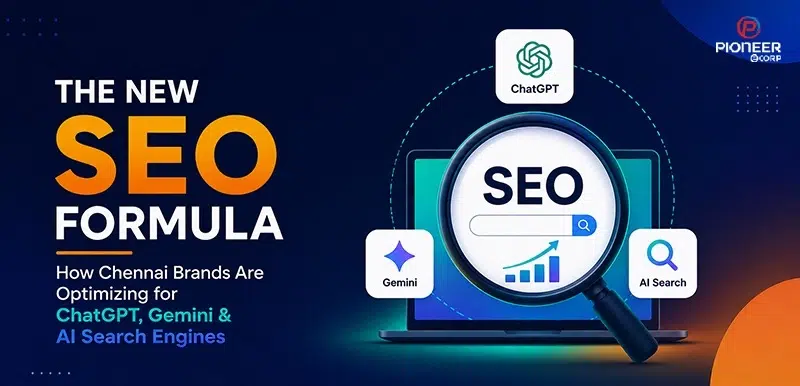
The New SEO Formula: How Chennai Brands Are Optimizing for ChatGPT, Gemini & AI Search Engines
A Major Shift Is Happening in Search
Something unusual has started happening in digital marketing.
A few years ago, businesses competed for rankings.
Today, they are competing for answers.
That difference changes everything.
When people earlier searched on Google, they usually clicked multiple websites, compared services, read blogs, and spent time researching. Now the behavior is different. Users open ChatGPT, Gemini, or AI-powered search experiences and ask questions naturally, almost like speaking to another human.
Instead of searching:
“best SEO company Chennai”
Users now ask:
“Which Chennai agency actually understands AI search optimization?”
This small shift is quietly reshaping the entire SEO industry.
Many businesses still have not understood how serious this transformation is. They continue publishing old-style keyword blogs while AI search platforms are changing the way information is discovered online.
In Chennai, some brands are already adapting early.
And those businesses are beginning to gain attention faster than competitors still relying only on traditional SEO methods.
Chennai Businesses Are Noticing a New Pattern
Digital agencies across Chennai have started observing something interesting during the past year.
Website traffic behavior is changing.
Users are spending less time browsing random websites and more time trusting AI-generated responses. Instead of opening ten tabs, people now expect one accurate recommendation instantly.
This is especially visible in industries like:
- real estate
- healthcare
- education
- SaaS
- digital marketing
- local services
Customers now prefer quick answers over long research journeys.
That means brands must position themselves differently online.
Earlier, ranking on the first page was the goal.
Now, becoming the source AI systems trust is becoming equally important.
Search Is No Longer About Blue Links Alone
Traditional SEO was built around search rankings.
Businesses optimized:
- keywords
- backlinks
- metadata
- technical performance
Those factors still matter.
But AI search systems evaluate something deeper.
They try to understand:
- whether the content feels trustworthy
- whether the explanation sounds natural
- whether the website demonstrates expertise
- whether users genuinely benefit from the information
This is why many heavily optimized webpages are slowly losing impact.
Some articles rank technically but still fail to become part of AI-generated answers because they sound robotic, repetitive, or generic.
AI systems are becoming better at identifying content created only for rankings instead of real readers.
Why AI Platforms Are Changing Customer Behavior
People like AI search because it reduces effort.
Instead of searching multiple websites manually, users receive:
- summarized insights
- direct explanations
- comparisons
- recommendations
- quick guidance
That convenience is changing how users interact with businesses online.
A Chennai startup founder searching for marketing help may now ask:
“Which SEO strategy works best after AI search updates?”
A restaurant owner may ask:
“How can my local business appear in AI search recommendations?”
This creates a new challenge for brands.
Your content cannot simply exist online anymore.
It must deserve to be referenced.
What Chennai Brands Are Doing Differently in 2026
Some Chennai companies are already adjusting their strategy for this new environment.
Interestingly, they are not focusing only on keywords anymore.
Instead, they are focusing on:
- deeper topic coverage
- real industry insights
- conversational writing
- local authority
- original perspectives
- practical knowledge
The difference becomes obvious when reading their content.
Older SEO blogs usually sound mechanical.
Modern AI-optimized content feels like an expert genuinely explaining something valuable.
That human layer matters more than many businesses realize.
The Real Reason Generic SEO Content Is Failing
The internet is now flooded with repetitive AI-generated articles.
Most of them look different on the surface but say almost the same thing underneath.
That is becoming a major problem.
Search systems are evolving fast enough to recognize:
- predictable structures
- repeated phrasing
- shallow explanations
- low-value content patterns
Many businesses still believe publishing more blogs automatically improves rankings.
But quantity alone no longer creates authority.
One insightful article built from genuine expertise often performs better than twenty generic keyword-focused posts.
This is exactly why many websites struggle despite publishing content regularly.
How Smart Businesses Are Becoming “The Answer”
The strongest-performing brands are changing their mindset completely.
They are no longer asking:
“How do we rank higher?”
Instead, they ask:
“How do we become the most trusted explanation online?”
That mindset shift changes content strategy entirely.
Successful brands now create content that:
- answers real customer concerns
- explains industry changes clearly
- includes original observations
- sounds natural
- avoids over-optimization
- prioritizes reader value first
AI search systems increasingly reward this style because it mirrors how humans naturally communicate.
Content Strategies That Actually Work Today
Many SEO tactics from the past still have value.
However, the way content is written now matters much more.
The businesses seeing stronger visibility in AI search are focusing on content that feels:
- useful
- experience-driven
- informative
- conversational
- specific
- trustworthy
Several content formats are performing especially well.
Detailed Industry Insights
Instead of writing broad generic topics, successful brands explain very specific changes happening inside their industry.
That specificity improves credibility.
Experience-Based Articles
Content built from real-world observations performs better because it feels authentic.
For example:
- campaign learnings
- ranking experiments
- customer behavior trends
- local market insights
These details are difficult to fake and help establish authority naturally.
FAQ-Focused Content
AI systems frequently extract direct answers from well-structured FAQ sections.
Clear, concise responses improve visibility significantly.
Comparison-Based Content
Users increasingly ask AI systems to compare tools, services, and strategies.
Content such as:
- “Traditional SEO vs AI SEO”
- “Google Search vs AI Search”
- “ChatGPT vs Gemini for business discovery”
can attract strong engagement.
Why Human Experience Matters More Than Ever
One major change happening in SEO is the growing importance of human experience.
Search systems are becoming better at identifying whether content feels:
- generic
- mass-produced
- repetitive
- emotionally disconnected
This is why experience-based writing is becoming powerful again.
An article written by someone actively working with Chennai businesses carries more natural credibility than generic informational content created without practical understanding.
Real experience creates:
- unique phrasing
- original insights
- natural storytelling
- stronger trust
That combination is difficult for automated content systems to replicate convincingly.
The Rise of Conversational Search
Search behavior now looks more like conversation than traditional keyword searching.
People no longer type only fragmented phrases.
They ask complete questions.
Examples include:
- “Why are AI search engines affecting SEO?”
- “How can local businesses appear in ChatGPT answers?”
- “Will traditional SEO still work in the future?”
This means businesses must optimize content for natural language patterns.
Content that sounds overly robotic often struggles because conversational AI systems prefer responses that feel human and understandable.
Local SEO Has Entered a New Era
For Chennai businesses, local SEO remains extremely important.
But local optimization itself is evolving.
Earlier, businesses focused mainly on:
- map listings
- citations
- location keywords
Today, AI systems also analyze:
- local reputation
- review quality
- business credibility
- website trust signals
- topical authority
A business with strong local trust and high-quality educational content has a better chance of appearing in AI-generated recommendations.
That is why local businesses can no longer depend only on directory listings.
Authority now matters more deeply.
Mistakes Businesses Continue to Make
Despite rapid changes in search behavior, many companies still rely on outdated practices.
Some of the most common mistakes include:
Publishing Content Without Original Insight
Generic blogs rarely create long-term visibility anymore.
Readers quickly recognize recycled information.
Obsessing Over Keywords Alone
Over-optimized content often sounds unnatural.
Modern SEO requires balance between optimization and readability.
Ignoring User Intent
Many businesses still create content based on keywords instead of actual customer questions.
That gap reduces engagement.
Treating AI Content as a Shortcut
AI can assist content creation.
But blindly publishing mass-generated articles without human refinement often weakens brand authority.
Weak Website Trust Signals
Businesses without clear credibility indicators may struggle in AI-driven search visibility.
Trust matters more than ever.
What the Future of SEO Looks Like
SEO is not disappearing.
It is evolving into something smarter.
The future of visibility will belong to businesses that:
- build trust
- demonstrate expertise
- create valuable experiences
- answer real questions
- sound genuinely human
AI search is rewarding clarity over manipulation.
This creates an advantage for businesses willing to invest in authentic, high-quality content instead of shortcuts.
For Chennai brands, the opportunity is massive right now because many competitors are still using outdated methods.
The businesses adapting early may dominate visibility for years.
People Also Ask (PAA)
Final Thoughts
A major transformation is happening quietly inside the search industry.
Businesses that continue creating repetitive keyword-heavy content may find it increasingly difficult to stand out as AI-powered search evolves.
The brands succeeding today are not simply chasing rankings anymore.
They are building trust, authority, clarity, and genuine value.
For Chennai businesses, this shift creates an important opportunity.
The companies willing to adapt early, communicate naturally, and share authentic expertise are far more likely to become the businesses AI platforms recommend in the future.
The next era of SEO will not belong to the loudest websites.
It will belong to the most believable ones.
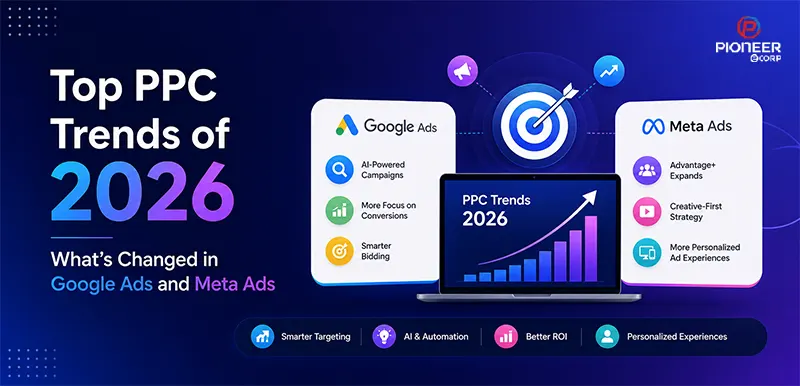
Top PPC Trends of 2026: What’s Changed in Google Ads and Meta Ads
Top PPC Trends of 2026: What's Changed in Google Ads and Meta Ads
The Top PPC Trends of 2026 are reshaping how businesses approach paid advertising across Google Ads and Meta Ads. From AI-driven campaign automation to privacy-focused targeting, the PPC landscape is no longer about simply running ads — it’s about smarter optimization, predictive audience behavior, and platform adaptability.
Brands investing in digital marketing and social media marketing must understand these changes now, or risk wasting budget on outdated strategies that no longer perform.
Table of Contents
- Introduction
- AI-Powered Campaigns Are Dominating PPC
- Search Intent Matters More Than Keywords
- Performance Max Campaigns Have Evolved
- Meta Ads Focus More on Creative Automation
- First-Party Data Is Becoming Essential
- Video Ads Are Outperforming Static Creatives
- Voice and Visual Search Ads Are Growing
- Smart Bidding Has Become More Aggressive
- User-Generated Content (UGC) Ads Are Winning
- PPC and SEO Are Becoming More Connected
- Conclusion
- FAQs
Introduction
PPC advertising in 2026 looks very different compared to just a few years ago. Platforms like Google and Meta are aggressively pushing automation, AI optimization, and machine learning-driven targeting. Businesses that still rely on manual keyword stuffing, broad targeting, or generic creatives are seeing declining ROI.
The biggest shift? Platforms now reward advertisers who provide better audience signals, stronger creatives, and conversion-focused landing pages rather than just increasing ad spend.
If your strategy hasn’t evolved, your competitors are already ahead.
AI-Powered Campaigns Are Dominating PPC
Artificial intelligence is now the backbone of both Google Ads and Meta Ads. In 2026, AI handles:
- Audience targeting
- Budget allocation
- Ad placement optimization
- Creative recommendations
- Bid adjustments
- Conversion prediction
Google’s AI can now predict user behavior with significantly better accuracy using historical intent signals and browsing patterns.
Meta’s Advantage+ campaigns have also become far more automated. Advertisers who fight automation instead of learning how to guide it are struggling to scale campaigns profitably.
What This Means for Advertisers
You no longer control every tiny setting manually. Your job is now to:
- Feed platforms high-quality data
- Create better ad creatives
- Improve landing page conversion rates
- Define strong audience signals
The platforms handle optimization faster than humans can.
Search Intent Matters More Than Keywords
One major change in the Top PPC Trends of 2026 is that exact-match keyword obsession is dying.
Google now heavily prioritizes:
- User intent
- Contextual understanding
- Behavioral signals
- Predictive search behavior
A campaign targeting “best generator rental company” may also trigger for related commercial intent searches without needing exact-match targeting.
The Problem Most Businesses Still Have
Many advertisers still:
- Overuse broad keywords
- Ignore search intent
- Send traffic to weak landing pages
- Focus on clicks instead of conversions
That approach burns budget fast.
Winning campaigns now align ad copy directly with user intent and solve a clear problem immediately.
Performance Max Campaigns Have Evolved
Performance Max campaigns were controversial when first introduced. In 2026, they’ve become far more effective because Google improved reporting transparency and audience segmentation.
Performance Max now integrates deeply across:
- YouTube
- Gmail
- Search
- Discover
- Maps
- Shopping
Businesses using strong creative assets and accurate conversion tracking are seeing excellent results.
However, There’s a Catch
Performance Max is not magic.
If your:
- Website is slow
- Conversion tracking is broken
- Creatives are weak
- Offer is poor
AI will optimize bad data faster.
That means automation amplifies both strengths and weaknesses.
Meta Ads Focus More on Creative Automation
Meta Ads in 2026 rely heavily on automated creative testing.
Facebook and Instagram now dynamically test:
- Headlines
- Hooks
- CTAs
- Video formats
- Captions
- Thumbnails
Instead of building one perfect ad, brands now create multiple creative variations and allow Meta’s AI to identify winners.
Why Most Meta Campaigns Fail
Most businesses still create boring ad creatives that:
- Look overly corporate
- Feel fake
- Lack emotional triggers
- Ignore mobile-first behavior
Users scroll aggressively. Weak creatives die instantly.
Winning ads now look:
- Native
- Authentic
- Fast-paced
- Short-form
- User-generated
First-Party Data Is Becoming Essential
Privacy regulations and cookie restrictions have changed PPC advertising permanently.
Third-party tracking is becoming weaker every year. Businesses that depend entirely on platform data are losing targeting accuracy.
That’s why first-party data is becoming critical.
Examples of First-Party Data
- Email lists
- Website visitor data
- CRM information
- Purchase history
- Lead forms
- Customer behavior tracking
Businesses collecting and organizing their own audience data are outperforming competitors significantly.
This is no longer optional in digital marketing.
Video Ads Are Outperforming Static Creatives
Short-form video is dominating both Google and Meta ecosystems.
Platforms prioritize:
- Reels
- Shorts
- Vertical videos
- Fast-moving visual content
Static image ads still work in some industries, but video ads consistently produce:
- Better engagement
- Lower CPC
- Higher CTR
- Stronger conversions
What Actually Works in 2026
High-performing PPC videos usually:
- Grab attention in first 3 seconds
- Show the product immediately
- Use subtitles
- Focus on customer pain points
- End with a strong CTA
Long introductions kill retention.
Voice and Visual Search Ads Are Growing
Voice search usage has increased massively through:
- Smart devices
- AI assistants
- Mobile search
At the same time, visual search is growing through Google Lens and image-based discovery.
This changes keyword behavior completely.
Users now search conversationally:
- “Which generator rental company is open near me?”
- “Best digital marketing agency for startups”
Advertisers must optimize campaigns around natural language queries and semantic intent.
Smart Bidding Has Become More Aggressive
Manual bidding strategies are fading rapidly.
Google’s Smart Bidding in 2026 uses:
- Real-time intent analysis
- Device behavior
- Geographic signals
- Historical conversion data
- User engagement probability
Manual CPC campaigns are still usable in certain niches, but automated bidding dominates large-scale PPC campaigns.
The Mistake Businesses Make
Many businesses panic when AI spends budget quickly during learning phases.
But cutting campaigns too early prevents optimization.
Good PPC management now requires:
- Patience
- Data interpretation
- Proper conversion tracking
- Strong attribution models
User-Generated Content (UGC) Ads Are Winning
Polished advertisements are losing effectiveness in many industries.
People trust people more than brands.
That’s why UGC-style ads dominate both Meta and YouTube campaigns.
High-Converting UGC Ad Formats
- Customer testimonials
- Product demos
- Behind-the-scenes videos
- Creator collaborations
- Real user experiences
These ads feel authentic and reduce audience resistance.
Especially in social media marketing, authenticity now matters more than polished production quality.
PPC and SEO Are Becoming More Connected
Smart brands no longer separate SEO and PPC completely.
They work together.
Example
SEO data helps identify:
- High-converting keywords
- User intent patterns
- Content opportunities
PPC data helps identify:
- Fast-converting offers
- High-performing headlines
- Audience behavior trends
Businesses integrating both channels improve overall marketing efficiency significantly.
This integrated strategy is becoming standard in modern digital marketing campaigns.
Conclusion
The Top PPC Trends of 2026 show one clear reality: automation, AI, creative quality, and first-party data now drive advertising success.
Google Ads and Meta Ads are becoming smarter every year. Businesses still relying on outdated PPC tactics are losing money while competitors using AI-assisted optimization scale faster.
The winners in 2026 are not necessarily the companies with the biggest budget. They are the businesses with:
- Better data
- Better creatives
- Better landing pages
- Better audience understanding
PPC is no longer just about running ads. It’s about building an intelligent conversion system.
FAQ
What is the biggest PPC trend in 2026?
AI-powered campaign automation is the biggest PPC trend in 2026. Both Google Ads and Meta Ads rely heavily on machine learning for targeting and optimization.
Are Meta Ads still effective in 2026?
Yes. Meta Ads remain highly effective, especially when using short-form video content and UGC-style creatives.
Is manual bidding still useful?
Manual bidding still works in some cases, but Smart Bidding strategies generally outperform manual optimization at scale.
Why is first-party data important for PPC?
First-party data improves audience targeting accuracy and helps businesses adapt to privacy restrictions and cookie limitations.
Which performs better in 2026: video ads or image ads?
Video ads generally outperform static image ads in engagement, CTR, and conversions across most industries.
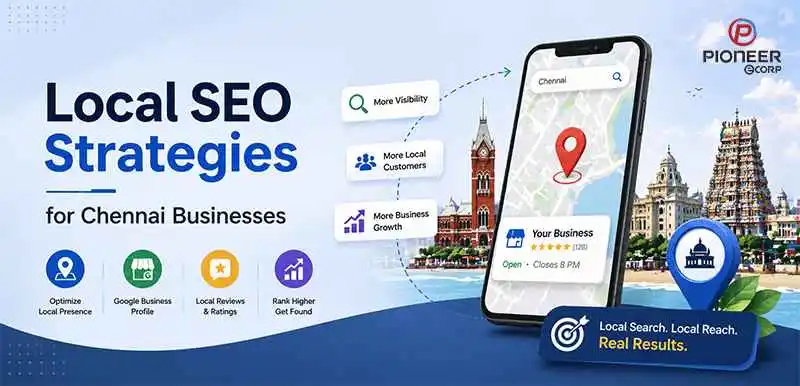
Local SEO Strategies Chennai Businesses Must Use Right Now in 2026
Introduction
If you’re running a business in Chennai in April 2026 and still using local SEO strategies from two years ago, you’re not just falling behind — you’re actively losing ground.
Google’s landscape has fundamentally shifted. The March 2026 Core Update tightened its grip on manipulative Google Business Profile tactics. AI Overviews now answer local queries directly on the search page. Voice search in Tamil and Tanglish is rising rapidly. And organic click-through rates for local mobile searches have declined as users interact with AI-generated summaries before ever seeing your listing.
The good news? For Chennai businesses willing to adapt, these changes represent a massive opportunity. As spammy, keyword-stuffed profiles get suspended and outdated strategies fail, businesses with authentic, well-structured local SEO will rise to fill the gap.
This guide reflects the current state of local SEO as of April 2026 — what’s changed, what still works, and what Chennai businesses need to do right now.
What Changed in Local SEO in 2026 — And Why It Matters for Chennai
Google’s March 2026 Core Update and GBP Crackdown
The single biggest shift in local SEO this year has been Google’s aggressive enforcement against Google Business Profile (GBP) spam. Across India and globally, businesses using keyword-stuffed profile names — like “Best AC Repair Service Velachery Chennai 24/7” — are being suspended without warning.
Google’s algorithm now uses advanced AI to detect manipulative patterns: bulk fake reviews, mismatched NAP data, inflated categories, and virtual addresses for service-area businesses. Once suspended, reinstatement can take weeks and is not guaranteed.
For Chennai businesses, this is actually positive news if you’ve been doing things the right way. The playing field is being levelled.
AI Overviews Are Reshaping Local Discovery
Google’s AI Overviews now appear in many local search results — summarising business options, hours, reviews, and services directly on the results page. For Chennai users searching “digital marketing agency in adyar” or “SEO company in Anna Nagar,” the AI summary often answers the query before a user clicks any link.
This means visibility in AI Overviews has become as important as ranking in the traditional Local Pack. Businesses with clean, accurate, structured data on their GBP and website are more likely to be cited by Google’s AI.
Tamil-Language and Voice Search Is Surging
India now has over 950 million active internet users, with Tamil-language digital content growing faster than English in metro cities like Chennai. Google’s NLP models in 2026 now understand Tanglish (Tamil + English) search queries accurately. If your business isn’t optimising for voice and vernacular searches, you’re invisible to a rapidly growing segment of Chennai’s population.
Local SEO Strategies That Actually Work for Chennai Businesses in 2026
1. Audit and Clean Your Google Business Profile First
Before implementing any new strategy, audit your GBP for compliance with Google’s 2026 guidelines. If your profile name includes keywords beyond your actual legal business name, change it immediately. The risk of suspension — and the traffic loss that follows — far outweighs any short-term ranking gain.
What a compliant, high-performing GBP looks like in 2026:
- Business name matches your legal registration exactly
- Primary category is precise (not inflated to capture unrelated searches)
- Photos are real, high-quality, and updated monthly
- Services and attributes are fully filled in — this data feeds AI Overviews
- Google Posts published at least weekly (Google now officially supports scheduling and multi-location publishing)
- Q&A section managed actively — note that Google has removed the traditional Q&A feature from Maps and replaced it with an AI-powered response system
- Reviews are genuine, recent, and responded to professionally
2. Optimise for AI Overviews and Answer Engine Optimisation (AEO)
In 2026, winning local search means being the source that Google’s AI cites — not just ranking in position one. This requires a shift in how you think about your website content.
How to optimise for AI Overviews as a Chennai business:
- Use clear FAQ sections on every service page, with questions phrased as Chennai customers actually ask them (“How much does social media marketing cost in Chennai?”)
- Implement LocalBusiness schema markup with complete JSON-LD — include your geo-coordinates, service areas, pricing range, and aggregate review rating
- Structure content with concise H2/H3 headings followed by direct, 2-3 sentence answers — AI systems extract answers from well-structured content
- Ensure Core Web Vitals are strong: LCP under 2.5 seconds, INP under 200ms, CLS under 0.1
A strong digital marketing service provider in Chennai should now include AEO audits as part of any SEO engagement — it’s no longer optional.
3. Create Tamil and Tanglish Content Strategically
This is the most underused local SEO strategy for Chennai businesses in 2026. Tamil-language digital content is seeing 156% higher growth in engagement compared to English-only content in metros. Google’s algorithms now fully understand Tanglish queries.
Practical steps:
- Add a Tamil-language FAQ block to your homepage and key service pages
- Publish at least one Tamil-language blog post per month targeting local queries
- Optimise your GBP description to naturally include Tamil transliterations of key services (e.g., “SEO சேவைகள் சென்னையில்”)
- Run Tamil-language Google Posts for local festivals and events (Pongal, Diwali, Tamil New Year campaigns get significantly higher local engagement)
This content also positions your business as a source for voice assistant searches — when Chennai users ask Siri or Google Assistant in Tamil, businesses with structured local content in both languages appear first.
4. Build Hyper-Local Landing Pages (Updated for 2026)
Location-specific landing pages remain one of the highest-ROI local SEO strategies — but the approach has changed. In 2026, Google penalises thin, copy-pasted location pages. Each page needs genuinely unique, locally relevant content.
For a Chennai SEO company serving multiple areas, this means creating distinct pages for Adyar, OMR, Nungambakkam, Anna Nagar, Velachery, and Tambaram — each with:
- Unique introductory paragraph referencing specific local context (nearby landmarks, business clusters, local clientele)
- Embedded Google Maps with your GBP pin
- Location-specific testimonials or case studies
- LocalBusiness schema with the exact pincode and service area
- An FAQ section answering queries specific to that locality
- WhatsApp click-to-chat button (critical for Chennai audiences — India has 850 million active WhatsApp users in 2026)
5. Manage Reviews Like Your Business Depends on It — Because It Does
Google’s review signals have become even more critical in 2026. AI Overviews pull review sentiment and volume directly into local summaries. Businesses with higher review counts and better average ratings are significantly more likely to appear in AI-generated local recommendations.
The 2026 review strategy for Chennai businesses:
- Send a direct GBP review link via WhatsApp immediately after service delivery — WhatsApp boasts a 98% open rate in India
- Use QR codes at your physical location (counters, receipts, menu cards)
- Respond to every review within 24 hours — AI Overviews favour businesses that demonstrate active engagement
- Never incentivise or purchase reviews — Google’s 2026 AI detection is sophisticated enough to identify bulk posting patterns, and the penalties are severe
- Flag and report fake reviews left by competitors — Google now has an improved review appeal process
Businesses with 80+ genuine reviews averaging above 4.4 stars are dramatically more likely to appear in the Local Pack and AI-generated summaries for competitive Chennai keywords.
6. Leverage Content Marketing Built Around Local Intent (Not Generic Topics)
The March 2026 Core Update significantly reduced traffic to generic, low-differentiation blog content. Content marketing in 2026 must be built around topics your competitors haven’t covered — particularly local, specific, experience-driven content.
High-performing content ideas for Chennai businesses:
- “How Chennai’s OMR Tech Corridor Businesses Are Winning Clients Through Local SEO in 2026”
- “Why 70% of Chennai Restaurant-Goers Discover New Places Through Google Maps (And How to Be One of Them)”
- “Social Media Marketing for Chennai’s Festive Season: What Works, What Doesn’t”
- Case studies featuring real Chennai clients with specific results and locality references
This type of content earns backlinks from local news outlets, industry publications, and Chennai-based business communities — which remains one of the strongest ranking signals for local SEO.
7. Integrate WhatsApp Commerce Into Your Local SEO Funnel
This is specific to the Indian — and Chennai — market in 2026. WhatsApp is no longer just a messaging app. Indian businesses now run end-to-end sales funnels through WhatsApp, with product catalogues, UPI payments, and AI chatbots all integrated into the platform.
From a local SEO perspective, adding a WhatsApp click-to-chat link to your GBP, website, and location pages dramatically improves conversion rates for mobile users — who make up the majority of local searchers in Chennai. Google also factors in engagement signals (calls, direction requests, website clicks) when ranking GBP profiles, and WhatsApp interactions via the platform can contribute to these signals.
8. Diversify Beyond Google — But Don't Abandon It
One of the clearest shifts in 2026 local SEO is the rise of multi-platform discovery. While Google remains dominant, Chennai consumers are discovering local businesses through Instagram Reels, YouTube Shorts, and Justdial with increasing frequency.
Social media marketing in 2026 means treating platforms as discovery engines, not just engagement tools:
- Instagram geo-tagged Reels featuring your location drive both social discovery and GBP view increases
- YouTube Shorts about your services with Chennai-specific titles rank in both YouTube and Google Search
- Ensure your Justdial and Sulekha listings are updated — these remain critical for Tamil Nadu business discovery
- Maintain consistent NAP data across all platforms — even a minor inconsistency between your Justdial listing and your GBP can suppress local rankings
What No Longer Works in 2026 (Avoid These)
- Keyword-stuffed GBP names — Instant suspension risk post-March 2026 Core Update
- Buying or generating fake reviews — Google’s AI detection is now sophisticated and penalties are severe
- Thin location pages copied across localities — Penalised as duplicate content
- Ignoring mobile Core Web Vitals — 75%+ of local searches in Chennai happen on mobile
- Generic, topic-saturated blog content — Traffic to undifferentiated articles dropped sharply after March 2026
- Relying solely on organic Local Pack — Local Services Ads now appear above the pack; ignoring paid local channels weakens your overall presence
Frequently Asked Questions (FAQ)
Q1: Has the March 2026 Google Core Update affected local businesses in Chennai?
Yes. The March 2026 Core Update, combined with Google’s GBP spam enforcement, has suspended numerous listings using manipulative tactics. For businesses with compliant, authentic profiles, this is an opportunity — many spammy competitors are losing visibility, opening up Local Pack positions for ethical players.
Q2: What is AI Overviews and how does it affect my Chennai business's local SEO?
AI Overviews are Google’s AI-generated summaries that appear at the top of many search results pages. They pull data from Google Business Profiles and websites to answer user queries directly. If your GBP is accurate and your website has well-structured, schema-marked content, you have a strong chance of being cited in these summaries — which can drive significant visibility even without a top organic rank.
Q3: Should I create Tamil-language content for local SEO in Chennai?
Absolutely. Tamil and Tanglish content is one of the most underutilised local SEO strategies in Chennai in 2026. Google’s NLP models now understand Tamil-English mixed queries, and voice search in Tamil is growing rapidly. Businesses with vernacular content consistently outperform English-only competitors for local queries.
Q4: How important are WhatsApp integrations for local SEO in 2026?
While WhatsApp itself is not a direct ranking signal, it is the most effective conversion tool for Chennai’s mobile-first audience. Adding WhatsApp click-to-chat buttons to your GBP and location pages significantly increases lead conversion rates. WhatsApp Commerce funnels — with catalogues, UPI payments, and chatbots — are now standard for competitive local businesses in Chennai.
Q5: Do I need a professional SEO company or digital marketing service to implement these strategies?
The foundational steps — GBP compliance, review management, WhatsApp integration — can be handled independently. However, technical AEO optimisation, LocalBusiness schema implementation, Core Web Vitals improvements, and multi-location content strategies are complex enough that partnering with an experienced SEO company in Chennai will produce faster and more reliable results, especially in competitive verticals.
Conclusion
Local SEO in Chennai in April 2026 is not what it was eighteen months ago. Google’s AI-driven search, the March 2026 Core Update, and the explosive growth of Tamil-language digital behaviour have reset the rules completely.
The businesses that will dominate local search over the next twelve months are those that build genuine, AI-readable authority — through clean Google Business Profiles, structured data, authentic reviews, vernacular content, and real engagement with Chennai’s mobile-first audience.
This isn’t about gaming algorithms. It’s about being genuinely discoverable, credible, and useful to someone in Anna Nagar or Velachery searching for what you offer right now.
If your current digital marketing service or SEO approach hasn’t been updated since 2024, the time to act is today — not after your competitors have already claimed the positions you’re leaving open.
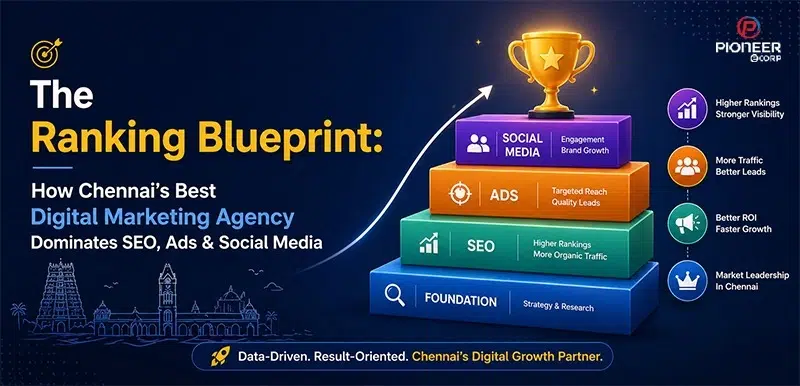
What Makes a Top Digital Marketing Agency? 7 Qualities to Look For
Introduction
In today’s competitive environment, simply having an online presence is no longer enough.
Businesses like digital marketing agency in Chennai are competing not just for attention, but for visibility at the exact moment customers are searching.
Some brands dominate search results, capture leads consistently, and build strong online authority. Others remain invisible despite having good services.
The difference lies in strategy.
This guide explains a proven digital growth blueprint used by high-performing agencies to dominate search rankings, paid campaigns, and social engagement — all at the same time.
Chennai’s Digital Shift: Why Marketing Has Changed
Customer behavior has evolved rapidly.
People no longer depend on traditional advertising. Instead, they:
- Search online before making decisions
- Compare multiple options
- Trust brands with visibility and reviews
If your business doesn’t appear in that journey, you lose potential customers before the conversation even starts.
This is why digital marketing is no longer optional — it’s foundational.
What Truly Defines a Top Digital Marketing Agency
Not every agency delivers results.
The best agencies operate with a system-driven approach, not random execution.
Key characteristics:
- Strategic planning based on real data
- Deep expertise in Search Engine Optimization
- Strong focus on ROI, not vanity metrics
- Integration of SEO, ads, and social media
- Continuous testing and refinement
They don’t just increase traffic — they build predictable growth systems.
SEO Growth Framework (Beyond Basic Optimization)
SEO is the backbone of long-term visibility.
But modern SEO is no longer about inserting keywords — it’s about building authority and relevance across an entire topic.
Technical Foundation
Search engines rely on structure.
Top-performing websites ensure:
- Fast loading speeds
- Mobile-first design
- Clean URL architecture
- Proper indexing and crawl efficiency
A technically strong website makes it easier for search engines to understand and trust your content.
On-Page Intelligence
On-page SEO has evolved into context-based optimization.
Instead of repeating keywords, agencies now:
- Structure content around topics
- Use related search terms naturally
- Optimize headings for clarity and hierarchy
This improves both user experience and search engine interpretation.
Content Authority System
Content is no longer about volume.
It’s about depth and usefulness.
Winning content:
- Answers real questions
- Covers topics completely
- Keeps readers engaged
Search engines reward content that solves problems better than competitors.
Paid Advertising That Actually Generates Leads
Paid ads provide immediate reach — but only when executed strategically.
Top agencies use platforms like:
- Google Ads
- Meta Ads Manager
What makes campaigns successful:
- Clear targeting based on intent
- Strong landing pages designed for conversion
- Continuous testing and optimization
- Retargeting to capture missed opportunities
The goal is simple: turn clicks into qualified leads efficiently.
Social Media as a Trust-Building Engine
Social media is where brand perception is built.
Platforms like:
help businesses stay connected with their audience.
Effective strategy includes:
- Educational and value-driven content
- Consistent posting schedule
- Visual storytelling (reels, videos)
- Audience engagement and interaction
Trust built on social media directly impacts buying decisions.
Conversion Optimization: Turning Traffic into Revenue
Getting visitors is only half the job.
Real growth happens when visitors take action.
Key optimization areas:
- Clear and compelling call-to-actions
- Simple and fast navigation
- Trust elements like reviews and testimonials
- Mobile-friendly design
Small improvements here can significantly increase lead generation.
AI & Automation in Modern Marketing
Artificial intelligence is transforming digital marketing workflows.
It helps in:
- Identifying keyword opportunities
- Analyzing user behavior
- Automating repetitive tasks
- Improving targeting accuracy
However, strategy and decision-making still require human expertise.
Real Execution Model Used by Top Agencies
Successful agencies follow a structured process:
- Analyze current website performance
- Study competitors in the Chennai market
- Identify keyword opportunities
- Build content and campaign strategy
- Execute SEO and advertising
- Track performance metrics
- Continuously improve
This cycle ensures consistent growth over time.
Why Businesses Prefer Chennai-Based Agencies
Working with a local agency offers advantages:
- Better understanding of local audience behavior
- Faster communication and execution
- Knowledge of regional market trends
- Stronger targeting for local SEO
A Chennai-focused strategy delivers more relevant results.
People Also Ask (PAA)
Conclusion
Businesses that succeed online don’t rely on shortcuts.
They follow structured strategies, adapt to changes, and consistently optimize their digital presence.
In a competitive market like Chennai, combining SEO, paid advertising, and social media is essential for long-term success.
The right approach doesn’t just increase visibility — it builds sustainable growth.
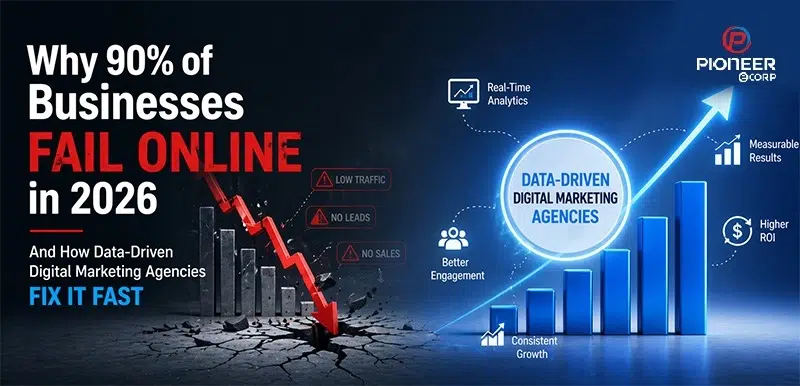
Why 90% of Businesses Fail Online in 2026 — And How Data-Driven Digital Marketing Agencies Fix It Fast
Introduction
In 2026, launching a website is easier than ever—but building a successful online business is harder than ever.
Thousands of businesses go live every day. Yet, nearly 90% of them fail within the first year.
The reason isn’t bad products. It’s a bad strategy.
This article breaks down why businesses fail online and how data-driven digital marketing agencies turn struggling brands into high-performing revenue machines—fast.
The Reality of Online Business Failure in 2026
The digital space is brutally competitive.
- Over 2 billion websites exist
- Millions compete for the same keywords
- Attention spans are shorter than ever
Without a clear strategy, your business becomes invisible.
Most businesses fail not because of effort—but because of lack of direction and data.
Top Reasons Why Businesses Fail Online
1. No Clear Digital Strategy
Many businesses jump into:
- Website creation
- Social media posting
- Running ads
But without a goal-driven strategy, everything becomes random.
Result: No traffic, no leads, no growth.
2. Poor SEO Execution
SEO in 2026 is not just keywords.
It requires:
- Search intent optimization
- Content depth
- Internal linking
- Technical SEO
Businesses that ignore this never rank on Google.
3. Weak Website Experience
If it has:
- Slow loading speed
- Poor design
- Confusing navigation
Visitors leave within seconds.
This increases bounce rate and kills conversions.
4. No Data-Driven Decisions
Most businesses rely on:
- Guesswork
- Assumptions
- “What feels right”
But in 2026, marketing runs on data, not opinions.
5. Ignoring Conversion Optimization
Traffic alone doesn’t matter.
If your website doesn’t convert visitors into:
- Leads
- Calls
- Sales
Then all efforts are wasted.
What Is Data-Driven Digital Marketing?
Data-driven marketing means:
Every decision is backed by real user data
This includes:
- Search behavior
- User clicks
- Heatmaps
- Conversion tracking
- Audience insights
Instead of guessing, agencies analyze and optimize continuously.
How Data-Driven Agencies Fix Problems Fast
1. SEO & Search Visibility
Agencies fix SEO by:
- Identifying high-intent keywords
- Optimizing content structure
- Fixing technical issues
- Building topical authority
Result: Higher rankings, more organic traffic
2. Performance Marketing (Paid Ads)
They don’t waste money on ads.Instead, they:
- Target the right audience
- Test multiple creatives
- Optimize based on ROI
Result: Faster lead generation
3. Conversion Rate Optimization (CRO)
Agencies improve:
- Landing pages
- Call-to-actions
- User journey
Even a 1% increase in conversion can double revenue.
4. Analytics & Tracking
They track everything:
- User behavior
- Traffic sources
- Conversion paths
Tools like dashboards help identify:
- What’s working
- What’s failing
Step-by-Step Growth Framework Used by Agencies
- Audit – Website, SEO, ads, content
- Research – Keywords, competitors, audience
- Strategy – Clear roadmap for growth
- Execution – SEO + ads + content
- Optimization – Continuous improvement
- Scaling – Increase ROI and revenue
Real-World Example
A business struggling with:
- No traffic
- Low leads
After implementing a data-driven strategy:
- SEO traffic increased by 300%
- Leads improved by 5X
- Cost per lead reduced by 40%
👉 This is the power of data-driven marketing.
Tools & Technologies Used by Agencies
Top agencies rely on:
- Analytics platforms
- SEO tools
- Heatmap tracking tools
- Ad optimization platforms
These tools help make smart, fast decisions.
Future Trends in Digital Marketing (2026 & Beyond)
- AI-driven personalization
- Voice search optimization
- Hyper-targeted ads
- First-party data strategies
Businesses that adapt will dominate.
People Also Ask (PAA)
Final Thoughts
In 2026, success online is not about working harder—it’s about working smarter.
Businesses that rely on:
- Guesswork
- Random strategies
- Outdated methods
Will fail.
But those that use:
- Data
- Analytics
- Strategic execution
Will scale faster than ever.
The difference is clear:
Data-driven digital marketing is no longer optional—it’s essential.
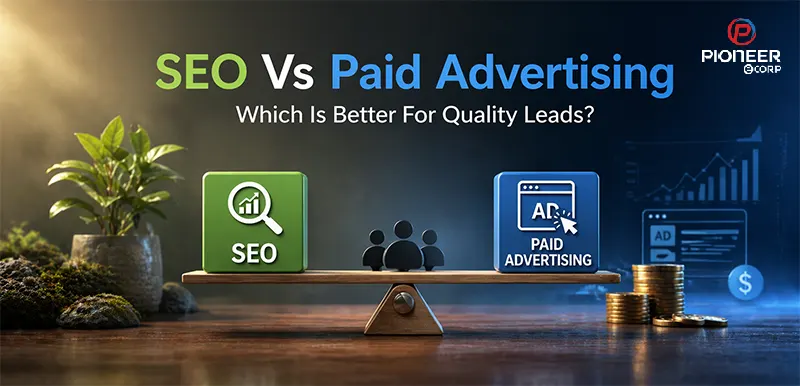
SEO Vs Paid Advertising: Which Is Better for Quality Leads?
Table of Contents
- Introduction
- What Is SEO?
- What Is Paid Advertising?
- SEO vs Paid Ads: The Core Differences
- Which Delivers Better Quality Leads?
- Comparison Table: SEO vs Paid Ads
- Step-by-Step Framework: Choosing the Right Strategy
- When to Use SEO, Paid Ads, or Both
- The Role of Social Media Marketing
- Real-World Example
- FAQs
- Conclusion
Introduction
If you have been running a business online, you have probably asked this question at least once: SEO vs paid ads — which one is actually worth my time and money?
It is one of the most debated topics in digital marketing today. Both strategies can bring traffic to your website. But when it comes to quality leads — people who are genuinely ready to buy — the answer is a bit more nuanced.
In this guide, we break down both approaches clearly, compare them head-to-head, and help you figure out which one fits your business goals best.
What Is SEO?
SEO (Search Engine Optimization) is the process of improving your website so it ranks higher on search engines like Google — without paying for placement.
It involves:
- Optimizing your website content with the right keywords
- Building backlinks from trusted websites
- Improving your site speed and mobile experience
- Creating helpful, high-quality content that answers user questions
SEO is a long-term play. It takes time to build, but once you rank well, the traffic keeps coming — for free.
Key benefit: Organic traffic builds trust. Users who find you through search tend to see your brand as more credible.
What Is Paid Advertising?
Paid advertising (also called PPC — Pay Per Click) means you pay to show your ads to your target audience. The most popular platforms include:
- Google Ads — your ad appears at the top of search results
- Facebook and Instagram Ads — part of social media marketing, ideal for targeting by demographics and interests
- LinkedIn Ads — great for B2B lead generation
- YouTube Ads — powerful for video-based brand awareness
With paid ads, you get instant visibility. The moment your campaign goes live, your business can appear in front of thousands of potential customers.
Key benefit: Speed and precision. You can target specific audiences and see results within hours.
SEO vs Paid Ads: The Core Differences
At the heart of it, these two strategies work in very different ways:
SEO earns its position over time. You create content, optimize your site, and gradually climb the search rankings. There is no direct cost per click, but it requires consistent effort — content creation, technical updates, and link building.
Paid advertising buys its position immediately. You set a budget, choose your audience, and your ad goes live. But the moment your budget runs out, your visibility disappears.
Think of SEO like planting a tree. It takes months to grow, but once it does, it provides shade year after year. Paid ads are more like renting a billboard. It works while you are paying for it.
Which Delivers Better Quality Leads?
This is the real question — and the answer depends on what kind of lead quality you are measuring.
SEO Leads: High Intent, High Trust
People who find your website through organic search are usually deep in the research phase. They searched for something specific, found your content, and clicked because it matched what they needed. This kind of visitor often converts better because:
- They came to you on their own terms
- They spent time reading your content
- They already see you as a credible source
According to industry data, SEO leads have a significantly higher close rate compared to outbound leads like cold calls or display ads.
Paid Ad Leads: Fast, Scalable, Targeted
Paid ads let you put your offer in front of the exact person you want — by age, location, interest, job title, and more. This is especially powerful in social media marketing, where platforms like Facebook and Instagram have rich user data.
However, paid ad leads can be more “top of funnel” — people who saw your ad but were not necessarily searching for you. Conversion depends heavily on how compelling your ad and landing page are.
Verdict: SEO tends to bring higher-quality leads over time. Paid ads bring faster, more scalable volume but may require more nurturing.
Comparison Table: SEO vs Paid Ads
| Factor | SEO | Paid Advertising |
|---|---|---|
| Cost | Low (time investment) | High (ongoing budget) |
| Speed of Results | Slow (3–6 months) | Fast (immediate) |
| Lead Quality | High intent, high trust | Variable, depends on targeting |
| Longevity | Long-lasting | Stops when budget ends |
| Scalability | Gradual | Highly scalable |
| Click Trust | High (organic results trusted more) | Lower (ads are labeled) |
| Best For | Long-term brand building | Quick campaigns, product launches |
| Technical Skill Needed | Moderate to high | Moderate |
| ROI Timeline | 6–12 months | Immediate but ongoing cost |
Step-by-Step Framework: Choosing the Right Strategy
Use this simple framework to decide what works for your business:
Step 1: Define Your Goal Are you trying to build brand authority long-term? Go with SEO. Need leads this week for a product launch? Run paid ads.
Step 2: Check Your Budget If your budget is tight, invest in SEO — it pays off without ongoing ad spend. If you have a flexible budget and need fast results, paid ads give you control.
Step 3: Know Your Timeline New business with zero online presence? Paid ads can get you traction while your SEO builds up. Established website with good content? Double down on SEO.
Step 4: Analyze Your Audience Where does your ideal customer spend time? If they are on Instagram or LinkedIn, social media marketing through paid ads makes sense. If they search Google for solutions, SEO is your priority.
Step 5: Test, Measure, and Combine The smartest digital marketing strategy often uses both. Run paid ads for immediate leads while your SEO builds a steady organic pipeline.
When to Use SEO, Paid Ads, or Both
| Situation | Best Approach |
|---|---|
| New business, fast traction needed | Paid Ads |
| Limited budget, long-term growth | SEO |
| Product launch or seasonal campaign | Paid Ads |
| Establishing brand authority | SEO |
| Targeting very specific demographics | Paid Ads (Social Media Marketing) |
| Capturing high-intent search traffic | SEO |
| Maximum lead volume at scale | Both combined |
The Role of Social Media Marketing
It is worth noting that social media marketing sits at an interesting intersection of both worlds.
Organic social media (posting content for free) shares similarities with SEO — it builds trust and audience over time, but without the direct search intent signal.
Paid social media advertising (Facebook Ads, Instagram Ads, LinkedIn Ads) is powerful for awareness and retargeting. It works best when combined with a solid SEO strategy — your organic content builds credibility, while your paid social ads scale reach.
In a well-rounded digital marketing plan, all three — SEO, paid search ads, and social media marketing — play different but complementary roles.
FAQs
Conclusion
There is no single winner in the SEO vs paid ads debate — it depends entirely on your goals, timeline, and resources.
If you want sustainable, high-quality leads that compound over time, SEO is your foundation. If you need speed, scale, or precise audience targeting right now, paid advertising delivers. And when used together as part of a broader digital marketing strategy — supported by social media marketing — you get the best of both worlds.
The smartest businesses do not choose one over the other. They use SEO to build trust and paid ads to accelerate growth — then let the two strategies reinforce each other over time.
Start where you are. Build what lasts. And always keep testing.
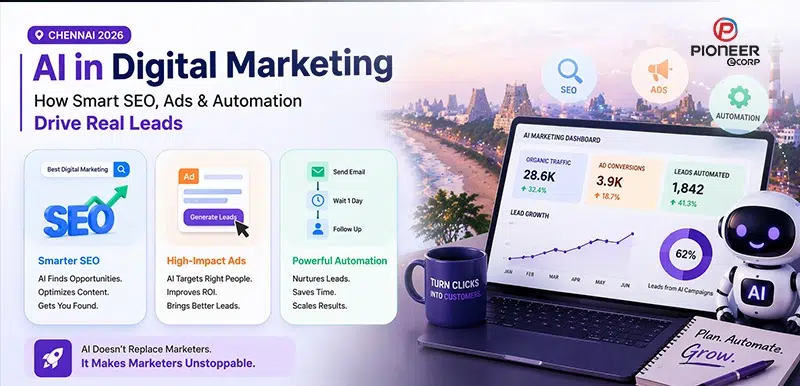
AI in Digital Marketing Chennai (2026): How Smart SEO, Ads & Automation Drive Real Leads
Introduction to AI in Digital Marketing
Artificial Intelligence is no longer a trend. It has become a core part of how modern businesses approach marketing.
From search rankings to paid ads and customer engagement, AI is changing how companies generate leads and scale growth.
For businesses in Chennai, this shift is happening fast.
Why Chennai Businesses Are Adopting AI
Chennai has a growing ecosystem of startups, service companies, and industrial businesses.
Competition is increasing across every sector.
Because of this:
- Traditional marketing is no longer enough
- Businesses need measurable results
- Lead generation must be consistent
AI helps solve these problems by making marketing smarter, faster, and more data-driven.
How AI is Transforming SEO Performance in 2026
AI is transforming how SEO works in 2026.
Earlier, SEO was based on manual keyword research and content writing. Now, AI tools analyze search intent, competition, and ranking patterns instantly.
How AI Improves SEO
- Identifies high-ranking keyword opportunities
- Predicts search trends
- Optimizes content structure
- Improves internal linking strategy
Real Impact
AI helps websites rank faster because it focuses on what users actually search for.
This improves:
- Click-through rate (CTR)
- Time on page
- Organic traffic
AI in Paid Ads (Google & Meta)
Paid advertising has become highly competitive.
AI plays a major role in optimizing ad campaigns.
Where AI Helps
- Audience targeting
- Budget optimization
- Ad copy testing
- Conversion tracking
Instead of guessing, AI analyzes user behavior and shows ads to people who are most likely to convert.
Marketing Automation with AI
Automation is one of the biggest advantages of AI.
It reduces manual effort and improves efficiency.
Examples of AI Automation
- Email follow-ups based on user actions
- Chatbots for instant response
- Lead scoring systems
- Retargeting campaigns
This ensures that no potential customer is lost.
Real Business Impact: Leads, Conversions & ROI
AI is not just about technology. It directly affects business growth.
What Businesses Experience
- More qualified leads
- Lower cost per lead
- Higher conversion rates
- Better return on investment (ROI)
For Chennai-based businesses, this means faster growth with controlled marketing budgets.
Key AI Tools Used by Digital Agencies
Modern agencies use a combination of tools to deliver results.
Common AI Tools
- SEO analysis tools
- Ad optimization platforms
- Automation software
- Analytics dashboards
Each tool helps in making better decisions backed by data.
Challenges & Limitations of AI
AI is powerful, but not perfect.
Key Challenges
- Requires proper setup
- Depends on quality data
- Can produce generic results if misused
- Needs human strategy for best outcomes
The strongest results come from blending AI capabilities with human decision-making.
Future of AI in Chennai Digital Marketing (2026+)
The future is clearly AI-driven.
What to Expect
- Fully automated campaigns
- Hyper-personalized marketing
- Voice and visual search optimization
- Real-time decision-making
Businesses that adopt AI early will have a strong competitive advantage.
People Also Ask (PAA)
Conclusion
AI is transforming digital marketing in Chennai.
It helps businesses move from guesswork to data-driven decisions.
From SEO to paid ads and automation, AI improves every stage of the marketing funnel.
Companies that use AI effectively will generate better leads, reduce costs, and scale faster.
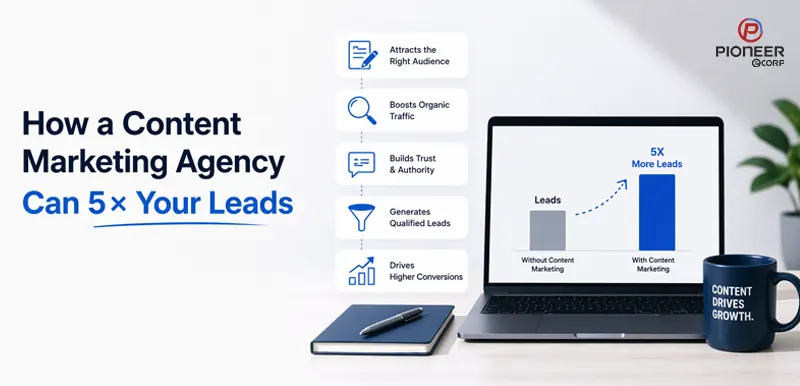
How a content marketing agency can 5 × your lead’s
Most businesses create content. Very few create content that consistently generates leads.
Here’s the honest breakdown of what separates the two — and where a content marketing agency fits into that gap.
If you’ve ever published a steady stream of blog posts, invested in social media marketing, and still found your leads stubbornly flat — you’re not imagining it. The content is there, but the pipeline isn’t moving. The frustrating truth is that content without a strategic foundation rarely converts. And that’s exactly the problem a good content marketing agency is built to solve.
This post breaks down why content-led lead generation works, what agencies actually do differently, and how to know if partnering with one makes sense for your business right now.
Why Content Marketing Works for Lead Generation
Before anything else, it’s worth grounding this in data. Content marketing isn’t a trend — it’s one of the most cost-efficient lead generation channels available in digital marketing today.
3×
More leads generated vs. traditional outbound, on average.
62%
Lower cost per lead compared to paid advertising alone.
47%
Of buyers consume 3–5 pieces of content before talking to sales.
What these numbers tell you is simple: your buyers are doing their research long before they fill out a contact form. If your content isn’t in front of them during that research phase — on Google, on LinkedIn, in their inbox — a competitor’s content is. That’s the opportunity cost of inconsistent content.
What "5× leads" actually means — and how it happens
When people talk about a content marketing agency multiplying leads, the math isn’t magic. It’s the compound effect of doing several things right simultaneously — things that most in-house teams struggle to maintain alongside everything else on their plate.
Here’s what that looks like in practice:
1. SEO that targets buying intent, not just traffic
Most businesses that write blog content target broad informational keywords — “what is content marketing,” for example. Agencies that actually generate leads go deeper. They map content to the full search journey, from awareness-stage questions all the way to high-intent, decision-stage keywords that signal someone is ready to hire or buy. That kind of SEO strategy is what turns a blog into a lead channel rather than a traffic vanity exercise.
2. Social media marketing as a distribution engine, not just a presence
There’s a significant difference between posting on social media and using social media marketing strategically. A content marketing agency repurposes long-form content — articles, guides, research — into platform-specific formats that reach audiences who’ll never find you through search. LinkedIn posts that spark conversation. Short-form videos that explain a concept and drive click-throughs. Email newsletters that bring readers back to your site. Each channel feeds the others.
3. Content that matches where the reader is in their journey
Not every blog reader is ready to buy. A lead generation-focused agency builds content for all three stages — awareness, consideration, and decision — and connects them with clear calls to action, lead magnets, and internal linking structures that guide readers toward conversion. This is something most solo content efforts miss entirely: treating every article like a standalone piece rather than a node in a larger system.
The brands that win aren’t the ones producing the most content. They’re the ones with the most intentional content — built around what their audience is searching for and what moves them to act.
Common mistakes businesses make without agency support
Publishing without a keyword strategy
Content written from internal knowledge, without SEO research, rarely surfaces in search. You might be answering the wrong questions — or the right ones in the wrong format.
Treating every channel independently
SEO, social media marketing, email, and paid digital marketing work best as a connected system. Siloed efforts produce siloed results.
Measuring the wrong metrics
Page views and follower counts feel good but don’t tell you if content is generating pipeline. The right metrics are leads, qualified traffic, and content-attributed conversions.
Inconsistency killing compound growth
Content marketing compounds over time — but only when it’s consistent. A burst of activity followed by months of silence resets momentum every time.
What to look for before partnering with a content marketing agency
Not every agency will be the right fit. Here are the questions worth asking before you sign anything:
- Do they have case studies showing lead generation outcomes — not just traffic or engagement metrics?
- Is their SEO approach based on intent mapping, or just keyword volume?
- Do they integrate social media marketing with long-form content, or treat them as separate services?
- How do they measure ROI — and how often do they report on it?
- Do they take time to understand your sales cycle and buyer personas before creating anything?
How long before you see results?
This is the question every business asks — and deserves an honest answer. Organic content and SEO take time. Realistically, the first three months are about building the foundation: keyword strategy, content architecture, early publishing, and setting up distribution through email and social media marketing channels.
Months four through six are where traction begins. Content starts ranking, social posts start getting shared, and early lead data comes in. By month six to twelve, businesses with a consistent, well-executed content strategy typically see the kind of compounding returns — qualified inbound leads, lower cost per acquisition, growing domain authority — that justify the investment many times over.
The key word is consistent. This is why working with a dedicated team, rather than fitting content around everything else, tends to make the difference between results that plateau and results that grow.
Is a content marketing agency right for your business right now?
Content marketing agencies deliver the most value when a business has a clear target audience, a defined service or product, and the patience to invest in a channel that builds over time rather than delivering instant results like paid ads. If you’re looking for leads next week, paid digital marketing is probably the faster lever. If you’re building a long-term engine that keeps generating leads even when your ad budget dips — content is where the compounding happens.
The brands that grow consistently through content aren’t the ones who went viral once. They’re the ones who showed up with valuable, well-optimized content every single month — and built a digital marketing presence that their audience trusts.
Contact Best Content Marketing Agency
Let our experts build a data-driven social media strategy tailored to your goals.
Get Free Strategy